Marcus Jenkins never expected to find a home in a town that didn't want him. At twenty-seven, he had learned that the world rarely gives you what you expect. It gives you what you need, if you are willing to see it.
The route was called the "death route" at the UPS distribution center in Madison, Wisconsin. Everyone knew about it. A hundred and twenty miles of winding back roads through rural Wisconsin, serving a dozen tiny towns that most people had never heard of — places like Oak Creek, Stony Ridge, Willow Springs. The previous driver, a man named Earl Patterson, had worked the route for forty-two years. He had retired in the spring, and in the six months since, six different drivers had tried to replace him. Six had quit.
"Why does no one want this route?" Marcus asked his supervisor, a heavyset man named Frank who had been with the company for thirty years.
Frank looked at him over his reading glasses. "Because Earl Patterson was a legend. And legends leave big shoes to fill."
Marcus took the route anyway. Not because he was brave, and not because he was confident. He took it because he had a two-year-old daughter named Aaliyah who needed braces she was too young for yet, and an ex-wife who was tired of waiting for child support payments. He took it because his apartment in Madison cost more than he could afford on a standard route. The death route came with a ten percent hazard pay. That was the only reason anyone ever took it.
On his first Monday, Marcus woke up at 4:30 AM, kissed Aaliyah's photograph good morning, and drove two hours north to the beginning of his route. The first stop was Oak Creek — a town so small that the main street had exactly four buildings: a post office, a hardware store, a diner, and a church. The postmistress, a woman in her sixties named Gloria, was waiting on the steps when Marcus pulled up in his brown truck.
"You're new," she said. It was not a warm welcome. It was an accusation.
"Yes, ma'am. Marcus Jenkins. I'm taking over Earl's route."
Gloria studied him the way a librarian studies a noisy child. "You know anything about this route, young man?"
"I know it's long. I know nobody wanted it."
"Anything else?"
Marcus hesitated. "No, ma'am. That's about it."
Gloria took her package, signed for it without another word, and went back inside. Marcus stood on the steps, feeling the cold Wisconsin morning settle into his bones, and wondered if he had made a terrible mistake.
The first week was a disaster. He delivered a package to the wrong address. Got lost on a dirt road that didn't appear on any map. Locked his keys in the truck and had to wait two hours for a spare set to be delivered from Madison. The residents of Oak Creek watched him with suspicion, the way small towns watch anyone who has not been born within their borders.
But something kept Marcus going. It was not the money, though he certainly needed it. It was the memory of a conversation he had overheard in the diner on his third day.
"Young man's trying, Gertie," an old farmer had said to the waitress. "Give him a chance."
"He's not Earl," Gertie had replied.
"No," the farmer said. "But Earl wasn't Earl when he started either. He was just some kid from Indiana who didn't know a soul. Forty-two years later, he was family. Takes time."
Marcus held onto those words like a lifeline.
On the Friday of his second week, Marcus made a discovery that changed everything. He was delivering a package to a farmhouse on the outskirts of Stony Ridge. The house was old and paint-peeled, with a wraparound porch and a garden that had been beautiful once but had since been overtaken by weeds. An elderly woman answered the door. She was small and bent, with white hair pulled into a loose bun and hands that trembled as she reached for the package.
"Thank you," she said. "You're the new boy, aren't you?"
"Yes, ma'am."
She looked at him, her eyes sharp despite her age. "Earl used to bring my packages inside. He said it was too far for me to walk to the door and back. He'd set them on the kitchen table for me."
Marcus looked at the distance from the door to the kitchen table — maybe twenty feet. Twenty feet that this woman, with her trembling hands and bent back, would have to struggle through.
"May I?" he asked.
Her face softened. "That would be kind of you."
He carried the package inside. The kitchen was cluttered but clean, filled with the smell of freshly baked bread. A photograph on the wall showed a younger version of the woman standing next to a man in a brown UPS uniform — Earl. They were both laughing.
"That was taken ten years ago," she said, following his gaze. "Earl helped me through some hard times. My husband passed in 2010. My son lives in Milwaukee and visits twice a year. Earl was the one who checked on me. He brought my prescriptions when I couldn't drive. He fixed my porch step when it broke. He was... he was family."
Marcus nodded slowly. He was beginning to understand.
Over the next few weeks, Marcus started paying attention. He noticed that Mrs. Kowalski on Elm Street had a porch step that was rotting. He fixed it on his lunch break. He noticed that the Miller family needed their packages delivered to the back door because Mr. Miller's husband was bedridden with Parkinson's. He started using the back door. He noticed that the diner's regular coffee delivery was always left on the curb, so he started carrying it inside for Gertie.
And something remarkable happened. The town started to warm.
Gertie started pouring his coffee before he even sat down. Gloria waved from the post office window. The old farmer — whose name was Henry — left a bag of fresh apples on the truck's bumper with a note that said "For the new boy. Keep going."
But the moment that changed everything came on a cold November afternoon. Marcus was making his last delivery of the day, a package to a house on the edge of Willow Springs. The address was familiar — he had delivered there three times in the past month. Each time, an elderly man named Arthur answered the door. Each time, Arthur thanked him with a warmth that felt genuine.
But this time, Arthur did not come to the door. Marcus knocked. Waited. Knocked again. He was about to leave the package on the step when he heard a faint voice from inside.
"Come in. Door's open."
Marcus pushed the door open slowly. The house was dim, the curtains drawn. Arthur was sitting in an armchair by the fireplace, a blanket wrapped around his shoulders. He looked smaller than he had a month ago. Paler.
"Mr. Patterson? Are you okay?"
Arthur smiled weakly. "I've been better, son. The cancer's back. They told me yesterday."
Marcus set down the package and crossed the room. He knelt beside the old man's chair. "Is there someone I can call? Family?"
"My daughter lives in Chicago. I called her. She's coming tomorrow."
"Today," Marcus said. "I'll call her today. What's her number?"
Arthur reached for a scrap of paper on the side table. His hands were shaking so badly he could barely hold it. Marcus took it gently, found the number, and called Arthur's daughter. She was on her way.
Marcus stayed. He made Arthur a cup of tea, found the remote control for the television, and sat with him until the headlights of a car appeared in the driveway two hours later. He met Arthur's daughter at the door — a woman in her fifties with her father's eyes and a look of exhausted gratitude.
"Thank you," she whispered. "I don't know how long he was going to sit there alone."
"Earl would have stayed," Marcus said simply. "I'm just doing what he would have done."
She hugged him, a quick, fierce embrace that caught him off guard. "You're more like him than you know."
That night, driving back to Madison, Marcus thought about Earl Patterson. He thought about the forty-two years of small kindnesses that had built a legend. He thought about the porch steps and the prescriptions and the cups of tea. He thought about the way a man could leave a town and still be remembered — not for the packages he delivered, but for the love he delivered with them.
The next morning, Marcus stopped by the diner before his shift. Gertie handed him a cardboard box wrapped in brown paper.
"What's this?" he asked.
"Open it," she said.
Inside was a worn leather notebook, its pages yellowed with age, its spine cracked from years of use. Marcus opened it carefully. The first page was dated April 3, 1982. Earl's handwriting was precise, neat:
"Route Notes, Day One: Mrs. Kowalski (Elm St) — knees bad. Bring packages to the back door. Miller farm — Mr. Miller has Parkinson's. Knock gently, don't startle him. Stony Ridge Post Office — Gloria likes to chat. Give her five minutes every Friday. Arthur Patterson (Willow Springs) — lonely since wife passed. If he invites you in for coffee, say yes."
Marcus turned the pages, one after another. Forty-two years of notes. Forty-two years of knowing — not just addresses and delivery instructions, but people. Their struggles. Their joys. Their names.
At the bottom of the last page, dated May 2024 — the month Earl retired — there was a final note:
"If you're reading this, you're the one who took my route. I don't know your name. But I know this: the route is not about the packages. It never was. It's about the people at the other end of the delivery. Learn their names. Learn their stories. Carry their burdens when you can. And you'll never work a day in your life. — Earl Patterson"
Marcus closed the notebook and looked at Gertie. Tears were streaming down his face.
"He left it for you," Gertie said softly. "He told me before he retired that someone would come along. Someone who understood."
"How did he know?"
Gertie smiled. "He didn't. But he hoped."
That was three years ago. Marcus still drives the death route. He still wakes up at 4:30 AM and drives two hours north. But he doesn't think of it as the death route anymore. He thinks of it as the life route. He knows every name, every story, every dog that barks at his truck. He carries prescriptions, fixes porch steps, sits with the lonely, and calls the daughters who live too far away.
Earl Patterson passed away a year after Marcus started the route. At his funeral, Marcus stood in the back of the church and watched a town mourn a UPS driver as if he had been its mayor. Arthur Patterson — who had beaten the cancer, at least for now — gave the eulogy. He talked about the man who had brought him coffee and company and hope.
After the service, Arthur's daughter approached Marcus. "I never got to thank Earl properly," she said. "But I want to thank you. For staying with my father that day. For calling me. For being the kind of person who sees beyond the package."
Marcus shook his head. "I was just doing what Earl taught me."
"No," she said, pressing a small envelope into his hand. "You were doing what you were always meant to do. Earl just showed you the way."
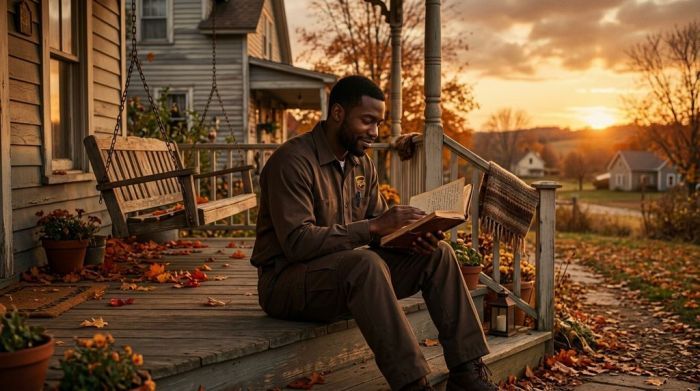
Marcus opened the envelope later that night, sitting on the porch of his apartment in Madison, the leather notebook open on his lap. Inside was a photograph — Earl Patterson, standing in front of his brown UPS truck on his last day of work, smiling the smile of a man who had spent forty-two years doing exactly what he was meant to do.
Pinned to the photograph was a note in Arthur's handwriting: "Earl would have wanted you to have this. Keep the route going, Marcus. The world needs more delivery drivers who understand that the most important thing we carry is not in the truck. It's in our hearts."
Marcus pinned the photograph to the wall above his desk. He added his own note to the bottom of Earl's notebook, right below the last entry: "Route Notes, Day One (My Turn): Oak Creek — Gloria's hip is getting worse. Bring her mail to the door. Mrs. Kowalski — new porch step installed. Remember to check it in spring. Arthur — still making coffee. Still saying yes. And always, always carry the love. — Marcus Jenkins"
There are still days when Marcus wonders if he made the right choice. Days when the Wisconsin winter is so cold his fingers go numb on the steering wheel. Days when Aaliyah asks why he has to leave so early. Days when the weight of other people's loneliness feels heavier than the boxes in the back of his truck.
But then he remembers Earl's notebook. He remembers Mrs. Kowalski's porch step, and Arthur's cup of tea, and the way Gloria's face lights up when he brings her mail to the door. And he knows. The route nobody wanted became the route he could not imagine living without.
Because that is the truth about small towns and the people who deliver to them. The packages are forgotten the moment they are opened. But the kindness? The kindness stays. It becomes a notebook passed from one driver to the next. It becomes a photograph pinned to a wall. It becomes a story that travels from porch to porch, from generation to generation, carried by people who understand that the most important deliveries are the ones that cannot be ordered online.
If you ever see a brown UPS truck on a winding road in rural Wisconsin, slow down. Wave. The driver might be Marcus Jenkins, a man from Madison who drove into a town that did not want him and found a family he never knew he needed.
He is carrying more than packages. He is carrying a legacy. One delivery at a time.