The last time Richard Parker saw his younger brother Bill, they were standing in their parents' living room in Columbus, Ohio, surrounded by cardboard boxes and the wreckage of a shared childhood. Their mother had been buried three days earlier. Their father had passed five years before that. And the house — the white farmhouse on Maple Street where they had grown up, fought over the television remote, and learned to drive in the dusty pickup truck — was being sold.
Richard wanted to keep it. He was the older brother, fifty-two years old at the time, a farmer who had never left the land he was born on. He had worked the soil of Franklin County his entire adult life, and the thought of some stranger living in his mother's kitchen, sleeping in his father's bedroom, felt like a betrayal of everything the Parker family had built.
Bill wanted to sell it. He was forty-nine, a successful architect living in Manhattan, married to a woman named Eleanor, with a son in private school. He saw the farmhouse as a relic of a past he had outgrown. He saw the money from the sale as a way to secure his son's future, to pay for college, to invest in a life that had moved far beyond the cornfields of Ohio.
The argument started over dinner at a diner on High Street. It escalated in the parking lot. It reached its breaking point on the porch of the farmhouse, under the same yellow light bulb that had guided them home from school dances and late-night hayrides. Richard said things he did not mean. Bill said things he had been holding in for forty-nine years. And when it was over, Bill got into his rental car, drove to the airport, and did not look back.
The house was sold. The money was split. And the silence between the Parker brothers stretched from days to months, from months to years, from years to decades.
Thirty years. That is how long two brothers can go without speaking when pride is louder than love.
Richard Parker was seventy-two years old in the spring of 2024, and he had been a widower for eight years. His wife Martha had passed away in 2016, leaving him alone in a smaller house on the edge of the farm, surrounded by machinery that no longer ran and memories that never stopped. His son lived in Cincinnati and called once a week. His daughter had moved to Oregon and sent photographs of mountains he would never visit.
He spent his days the way old farmers do — waking before dawn, making coffee that was mostly chicory, sitting on the porch to watch the sun rise over fields he no longer worked. He had leased the land to a neighbor, a young man named Cody who was kind enough to let Richard ride the tractor sometimes, just to feel the vibration of something familiar under his hands.
And on the nights when the loneliness pressed in like the Ohio humidity, Richard would open the bottom drawer of his nightstand and pull out a photograph. It was faded now, creased along the middle where it had been folded for too many years. It showed two boys, ages ten and seven, sitting on the fender of a 1968 Ford pickup truck. The older boy had his arm around the younger one. They were both laughing, their faces smudged with dirt, their hair wild from a summer day spent chasing each other through the cornfields.
Richard would look at that photograph and wonder where the older boy had gone. He had been someone's big brother once. He had taught Bill how to ride a bike, how to throw a curveball, how to change a tire. He had shared a bed with him during thunderstorms, had let him win at checkers when he was feeling generous, had threatened to beat up anyone who bullied him at school.
And then, in one terrible hour on a November evening, he had lost him.
The phone call came on a Tuesday, at 7:14 in the evening. Richard was watching the weather report, a habit he had never broken even though he no longer needed to plan around the harvest. The number on the caller ID was unfamiliar — a 212 area code. New York City.
He almost did not answer. He let it ring four times, staring at the screen, his thumb hovering over the decline button. But something made him pick up. Something he could not name.
"Richard?"
The voice was older. Deeper. But it was unmistakable. It was the voice of the boy he had taught to throw a curveball.
"Bill?" Richard's voice cracked on the single syllable. "Bill, is that really you?"
A long pause. Then: "Eleanor passed away six weeks ago. Cancer. I should have called you sooner. I should have called you a long time ago. But I didn't know how. And I still don't know how. But I'm standing in a hotel room in Columbus, and I've been sitting in my car outside the old farmhouse for three hours, and I don't know why I came here except that this is the only place that ever felt like home. And I don't know if you want to see me. I don't know if you ever want to see me again. But I had to try."
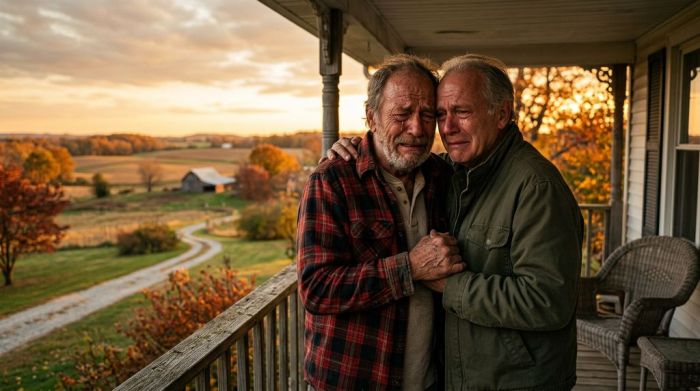
Richard did not remember standing up. He did not remember grabbing his keys. He did not remember driving the forty-five minutes to Columbus, the roads blurring past him as the sun sank behind the bare winter trees. All he remembered was walking up the steps of the farmhouse porch — their porch, the one from the photograph — and seeing a man standing there. A man with gray hair and tired eyes and a face that held thirty years of secrets.
They stood there, two old men, separated by three decades and three feet of wooden porch. The yellow light bulb cast the same shadows it had cast when they were boys.
"Hello, Richard," Bill said.
And Richard, who had not cried since the day he buried his mother, felt tears streaming down his face. "Hello, little brother."
The hardest journey is not across the country. It is across the space between two hearts that have forgotten how to beat together.
They sat on the porch steps, the same steps where their mother had taken their photograph on the first day of school every year. Bill talked first. He talked about Eleanor — about the forty-three years they had shared, about the way she had held his hand during chemo, about the last words she had whispered to him: "Call your brother."
He talked about the guilt that had eaten him alive for three decades. About the nights he had picked up the phone and put it back down. About the letters he had written and never sent, the same way their mother used to write letters to her sister and leave them in a shoebox under the bed. About the moment he realized that being right was not the same as being whole.
Richard listened. And then he talked. He told Bill about Martha, about the farm, about the night he had driven to the airport in 1994 with the intention of getting on a plane to New York, only to sit in the parking lot until his plane took off without him. He told him about the photograph in the nightstand drawer, and how he looked at it every single night, and how he had spent thirty years practicing an apology he never had the courage to deliver.
"I'm sorry," they said at the same time. And then they laughed — the same laugh, the one they had inherited from their father, a deep, rumbling sound that had once filled the hallways of the farmhouse.
The neighbors later said they heard two old men laughing and crying on that porch until well past midnight. They said it sounded like a dam breaking, like water finding its way through a crack in a wall that had held for far too long.
The next morning, the brothers went to the cemetery where their parents were buried. They stood side by side, two gray-haired men with the same jawline, the same walk, the same way of squinting into the morning sun. Richard had brought a thermos of coffee, the way their father used to do. Bill had brought wildflowers, the way their mother used to do.
They did not say much. They did not need to. After thirty years of silence, the quiet felt different now — not empty, but full. The way silence feels when two people finally understand each other.
Before Bill left to drive back to New York, Richard reached into his jacket and pulled out the photograph — the one from 1965, the two boys on the fender of the Ford pickup. He pressed it into his brother's hands. "I've had this long enough," he said. "It's your turn to hold it for a while."
Bill looked at the photograph. He saw two boys who had no idea that life would test them, that silence would nearly destroy them, that it would take thirty years and a devastating loss to bring them back together. He saw his brother's arm around his shoulders. He saw the laughter in their eyes.
"I'll bring it back," Bill said. "Next spring. We can take a new one."
Richard nodded, unable to speak.
That was six months ago. Bill calls every Sunday now. He is planning to retire at the end of the year, and he has been looking at a small house just ten miles from Richard's farm. The real estate agent thinks he is a nice old man looking for a quiet place to spend his golden years. He does not know that Bill is coming home to mend the last broken thread of a bond that should never have been cut.
And on Richard's nightstand, tucked beside the old photograph of his wife Martha, sits a new photograph. It was taken last spring, in front of the farmhouse on Maple Street. Two old men, gray-haired and weathered, their arms around each other the way they had done sixty years ago. They are not laughing in this photograph. They are crying. But it is the good kind of crying — the kind that comes when you realize that love has been waiting for you all along, patient as the turning of the seasons, steady as the light on a porch that never truly went out.
Because that is the truth about family. You can walk away. You can stay silent. You can let pride build walls that last for decades. But the spaces between us are never truly empty. They are filled with every laugh we ever shared, every meal we ever ate together, every storm we ever weathered side by side. And when we finally find the courage to cross that space, we discover that the distance was never as far as we thought.
All it takes is one phone call. One porch step. One simple word that has been waiting on the tip of your tongue for thirty years.
Hello, little brother.
I am here. I never left. And I have been waiting for you all along.