My wife Emily started coming home at midnight, and I never asked why.
I should have. That is the part that haunts me the most — not what she was doing, but the fact that I let three months pass without a single real question. I told myself she was just busy. I told myself she needed time with her friends. I told myself a hundred convenient lies because the truth was too uncomfortable to face.
The truth was, I was afraid of the answer.
My name is David Chen. I am thirty-three years old, and I teach American history at Jefferson High School in Portland, Oregon. It is not a glamorous job. It does not pay well. But it pays the bills — barely. The mortgage on our two-bedroom bungalow eats up forty percent of my salary. Emily's income as a dental hygienist covers the rest, with maybe fifty dollars left over at the end of the month if we are careful.
And I had a secret of my own.
For the past two years, I had been working on a novel. A historical fiction piece about the Chinese railroad workers who built the transcontinental railroad in the 1860s. It was a story that had consumed me since graduate school, a story I had carried in my chest like a second heartbeat. But teaching and grading and lesson plans left me with no time to write. So three months ago, I had made a decision: I would wake up at 4:30 every morning and write for two hours before school.
The problem was, I needed sleep. And tutoring. I had been tutoring three nights a week to bring in extra money — a former student's younger brother who was struggling with AP History. It paid seventy dollars a session, and we needed every cent.
But I could not keep doing both. I was running on empty, falling asleep at my desk, snapping at Emily over small things. I was becoming a ghost in my own marriage.
Then Emily made a suggestion.
"You should quit the tutoring," she said one evening, as we were washing dishes together. "You're exhausted, David. You can't keep this up."
"We need the money," I said.
"I'll pick up some extra shifts at the clinic. Dr. Patterson said he could use me on weekends."
"Em, you already work forty hours a week."
"I can handle it." She smiled, that warm, steady smile that had made me fall in love with her ten years ago. "Besides, your book is important. When are you going to write it if not now?"
That was how it started. I quit the tutoring. I started waking up at 4:30 AM, sitting at my laptop in the cold darkness of our spare bedroom, typing out the story that had been living inside me for so long. And Emily started working more.
At first, it was just weekends. Then she started coming home late on weeknights too. "Dr. Patterson scheduled a late patient," she would say. Or "Janet asked me to cover her shift." I never questioned it. I was too grateful. Too absorbed in my own world. Too selfish to see what was really happening.
The first clue came on a Tuesday night in March.
I had finished writing for the morning and was getting dressed for work when I noticed a small bruise on Emily's arm, just above her elbow. "What happened?" I asked, touching it gently.
She pulled her arm away. "Oh, nothing. I bumped into the cabinet at work."
It was a reasonable explanation. I accepted it without a second thought.
The second clue came two weeks later. I came home early from a teacher conference day and found Emily in the bathroom, rubbing cream into her hands. Her knuckles were red and raw, the skin cracked in several places.
"Em, your hands —"
"It's this cold weather," she said quickly. "Dry skin. I'm fine."
I should have pressed harder. I should have asked more questions. But I had a deadline — I had promised myself I would finish the first draft by April — and I let myself be distracted by the chapter I was struggling with. I let myself believe the easy lies she fed me.
The third clue came on a rainy Sunday in April.
Emily had left for "work" at noon. I was at my laptop, wrestling with the final chapter, when the doorbell rang. It was Emily's mother, Linda, standing on the porch with a casserole dish in her hands.
"Surprise!" she said. "I was in the neighborhood and thought I'd visit."
I invited her in, made coffee, and we chatted for a while. And then she asked the question that shattered everything.
"So, how's Emily liking her new job?"
I stared at her. "Her new job?"
Linda looked confused. "The one she started a few months ago. She told me she was working at a dental clinic in Beaverton. She said the pay was better."
I felt the room tilt. "She works at a dental clinic in Portland. She's been there for six years."
We looked at each other, two people slowly realizing that we were holding opposite pieces of the same puzzle.
"She told me she switched clinics in January," Linda said, her voice uncertain. "She said she was working nights now."
The clock on the wall ticked. The rain tapped against the window. I sat there, processing the information, feeling a cold dread settle into my bones.
That night, I waited for Emily to come home.
She walked in at 11:47 PM, her coat wet from the rain, her face tired. She looked surprised to see me sitting on the couch, the television off, the room dark except for a single lamp.
"David? Why are you still up?"
"Your mother came by today."
Emily's face went pale. She set her bag down slowly, carefully, as if it were filled with glass.
"She said you told her you switched clinics in January. That you were working nights in Beaverton."
Emily did not answer. She sat down on the armchair across from me, her hands folded in her lap, her eyes fixed on the floor.
"Where have you really been going, Em?"
The silence stretched between us like a wire pulled too tight. And then, in a voice so quiet I almost did not hear it, she told me the truth.
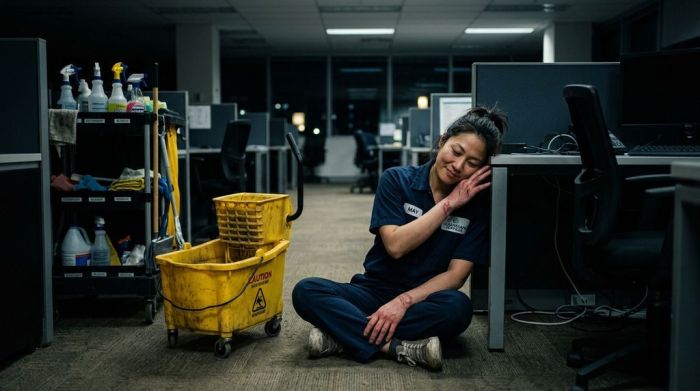
"I've been cleaning offices. At a business park on the south side."
I felt the words hit me like a physical blow. "What?"
"Dr. Patterson cut my hours in February. The clinic was overstaffed. He offered me part-time, but it wasn't enough to cover the difference. I applied for other dental jobs, but nothing came through. And you were so close to finishing your book. I couldn't let you stop. I couldn't let you give it up."
"Em... you work forty hours a week. You're exhausted."
"I work forty hours a week at the clinic. Then I go to the business park and clean offices from nine to midnight. Four nights a week." She finally looked up at me, her eyes red, her face wet with tears. "I'm not tired, David. I'm doing this for us. I'm doing this so you can finish your book. I'm doing this because I believe in you. I believe in your dream."
I crossed the room and knelt in front of her. I took her raw, cracked hands in mine and held them the way I should have held them weeks ago, when I first noticed the bruises, the redness, the exhaustion in her eyes.
"Your hands," I whispered.
"I wear gloves now. Most of the time."
"Why didn't you tell me?"
"Because you would have stopped me. You would have quit the book, gone back to tutoring, and buried your dream again. And I couldn't let that happen, David. I couldn't watch you give up on something that makes you come alive."
I cried that night. Not the quiet, controlled tears of a man who is moved by a sad movie, but the raw, ugly sobs of a man who realizes how deeply he has been loved and how little he has noticed.
The next morning, I opened my laptop and read the manuscript — all two hundred and eighty pages of it. It was not finished. It was not perfect. But it was alive. And it existed because my wife had scrubbed toilets and emptied trash cans and vacuumed carpets in a cold office building every night for three months.
I finished the first draft on May 1st, at 5:47 in the morning. I closed my laptop, walked into the bedroom, and found Emily still asleep, her bandaged hands resting on the pillow beside her face. I climbed into bed and wrapped my arms around her, pressing my face into her hair.
"I finished it," I whispered.
She stirred, half-asleep. "That's good, baby. That's really good."
"I want to dedicate it to you."
"Okay."
I held her tighter. "I mean it, Em. No one has ever believed in me the way you do. No one has ever loved me the way you love me. And I spent three months too busy to notice."
She turned in my arms and looked at me with those sleepy, beautiful eyes. "I didn't do it so you would notice, David. I did it because I love you."
"That's what makes it so hard to accept."
She smiled, that warm, steady smile that had carried me through the hardest years of my life. "Then just accept it. Accept that you are loved. Accept that your dream matters. And then go find a publisher."
I started querying agents that summer. The rejections came fast and hard, a steady stream of "not for us" and "not quite right" that would have crushed me if I had been doing it alone. But I was not alone. Emily read every rejection with me, made me laugh at the worst ones, and insisted that it only took one yes.
The yes came in September.
A small independent press in Seattle offered me a contract. The advance was modest — five thousand dollars — but it did not matter. What mattered was that someone believed in the story. What mattered was that the railroad workers I had carried in my chest for so long would finally have their voices heard.
The book was published in May of the following year. It did not make the New York Times bestseller list. It did not make me rich or famous. But it found its audience — history teachers, railroad enthusiasts, the grandchildren of men who had laid tracks across the Sierra Nevada. I received letters from people who said the book made them cry. I received emails from readers who said they had never known about the Chinese workers, and that my book opened their eyes.
But the letter that mattered most came in a plain white envelope, delivered to our mailbox on a Tuesday afternoon.
I opened it at the kitchen table, with Emily sitting across from me, drinking her morning coffee. It was from a woman named Mrs. Helen Park, who lived in Sacramento, California. Her grandfather was one of the men I had written about. She said she had waited her whole life for someone to tell her family's story.
"I am ninety-two years old," she wrote, "and I never thought I would see my grandfather's name in a book. Thank you for bringing him back to life. Thank you for remembering."
I read the letter aloud to Emily, my voice cracking on every sentence. When I finished, I looked at my wife, and I understood, truly understood, what she had given me.
She had not just given me time to write. She had not just paid the bills while I chased a dream. She had given me the courage to keep going when the rejections piled up. She had given me the space to fail, and the support to succeed. She had cleaned offices at midnight so that a ninety-two-year-old woman in Sacramento could see her grandfather's name in print.
That was five years ago.
I still teach at Jefferson High. I still wake up at 4:30 in the morning to write. My second novel — about a Japanese American family during World War II — is almost finished. Emily still works at the dental clinic, but she cut back to thirty hours a week. She does not clean offices anymore. She does not have to.
But I still think about those three months. I still think about the bruises and the cracked hands and the lies she told to protect my dream. I think about the suitcase under the bed — the one I found after she confessed, stuffed with a uniform and a pair of worn-out sneakers and a bus pass that she used to get to the business park because she did not want me to notice the extra mileage on the car.
The suitcase is in our closet now. I see it every morning when I get dressed. It is no longer a hiding place. It is a reminder.
It reminds me that love is not always loud. Sometimes it is quiet and hidden and asks for nothing in return. Sometimes it scrubs floors in the dark so someone else can chase a dream. Sometimes it comes home at midnight with raw hands and a tired smile and never once complains.
It reminds me that I am married to a woman who would rather sacrifice her own comfort than see me give up on something that matters to me. And it reminds me to never, ever stop noticing.
Because the truth is, we all have suitcases under our beds. We all carry secrets we think we need to protect. But the love that changes us — the love that saves us — is the love that refuses to stay hidden. It is the love that walks into the light, cracked hands and all, and says, "I did this for you. And I would do it again."
Emily is asleep beside me as I write this. Her hands are smooth now, the cracks healed, the bruises long gone. She stirs in her sleep and mumbles something I cannot quite hear. I think it is my name.
I lean over and kiss her forehead.
"I know," I whisper. "I know what you did. And I will spend the rest of my life being grateful."
Because some stories do not begin with "once upon a time." They begin with a suitcase under the bed, a wife who lied to protect a dream, and a man who finally learned to see.
This is our story.
And I would not change a single word.