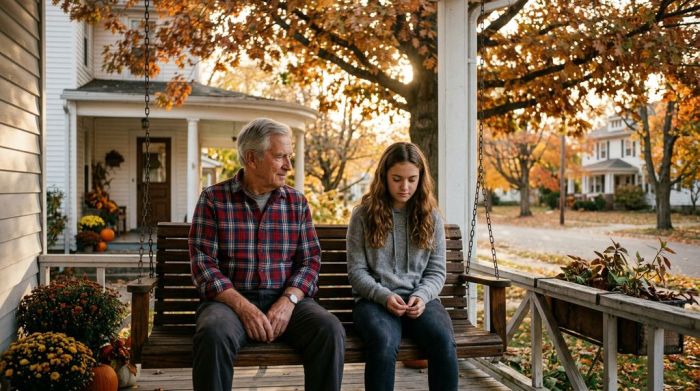
Walter Jenkins never expected to find a friend on the swing he built for his dying wife. But that is exactly what happened on a warm September afternoon when a teenage girl with haunted eyes sat down beside him and changed everything.
For five years, Walter had been coming to this spot. Every afternoon at exactly 3:47 PM, he would walk out of his white clapboard house on Maple Street, lower himself onto the wooden swing with a quiet groan, and begin to rock. Back and forth. Back and forth. The chains creaked in a rhythm that had become as familiar to him as his own heartbeat.
The neighbors thought he was just an old man passing time. They waved as they drove by, their hands lifting from steering wheels in quick, friendly gestures. Walter would nod back, but his eyes would drift past them, settling on the empty space beside him on the swing. A space that had been occupied in his dreams every single night for the past 1,826 days.
Eleanor had asked for the swing on a Tuesday. Walter remembered it clearly because it was the same Tuesday the hospice nurse had told him they were down to weeks, not months. Eleanor had been sitting up in bed that day, her eyes clearer than they had been in a long time, a sign the nurse called "the final rally." She had reached for his hand with fingers that felt like bird bones wrapped in paper-thin skin.
"Walter," she had whispered, her voice a thread of its former self. "Do you remember the porch swing at my grandmother's house?"
He remembered. He remembered everything about that summer of 1965 when he was twenty-two years old and had fallen in love with a girl who laughed like wind chimes. Her grandmother's house in rural Kentucky had a creaky wooden porch swing where they had spent countless evenings, his arm around her shoulders, her head resting against his chest, watching fireflies blink in the twilight.
"I want you to build me one," Eleanor had said. "Right here in the front yard. Under the oak tree."
Walter had looked at her, confused. "The front yard, Ellie? Not the porch?"
"The front yard," she had insisted, a ghost of her old stubbornness flickering in her eyes. "I want to see the neighbors. I want to watch the children play. I want... I want to be part of the world, even if I can't be in it anymore."
The next morning, Walter had driven to the hardware store and bought more lumber than he needed. He had spent three days building the swing — measuring, sawing, sanding, staining. He built it larger than necessary, wide enough for two people. Wide enough for Eleanor to sit beside him, wrapped in her favorite patchwork quilt, her hand in his.
But Eleanor never sat on that swing. She passed away on a Thursday, three days before Walter finished the final coat of varnish. He had stood alone in the front yard, staring at the empty swing, feeling the weight of a promise kept too late.
He sat on it for the first time the day after her funeral. And he had not stopped sitting on it since.
The Girl Who Appeared From Nowhere
She arrived in the neighborhood the way stray cats do — quietly, without announcement, without anyone noticing until she was already there. Walter first saw her on a Thursday afternoon in September, sitting on the curb across the street from his house. She was wearing a gray hoodie that was too big for her thin frame, her dark hair falling across her face like a curtain she had drawn against the world. She was staring at her phone, but she was not scrolling. She was just staring, the way people stare at screens when they are trying not to look at something else.
Walter did not approach her. He had learned, over eighty years of living, that people in pain needed space, not intrusion. He simply sat on his swing and let the afternoon pass, rocking gently, the chains creaking their familiar song.
The girl appeared again the next day. And the day after that. And the day after that. She never spoke. She never looked up. She just sat on the curb, a small, still figure against the backdrop of a neighborhood that had long since stopped being curious about her.
It was on the seventh day that something changed. A light rain had begun to fall, a soft September drizzle that beaded on the leaves of the oak tree and dripped onto the grass. Walter had been about to go inside when he noticed the girl was still sitting on the curb, making no move to seek shelter. Her hoodie was darkening with moisture, her shoulders hunched against the cold.
Walter made a decision. He walked to the front door, grabbed the umbrella from the stand, and carried it across the street. He held it over the girl's head, sheltering her from the rain. She looked up, startled, her eyes meeting his for the first time. They were brown eyes, deep and tired, carrying a weight that no teenager should have to bear.
"You're getting wet," Walter said simply.
"I don't mind," she replied, her voice barely above a whisper.
"Well, I do. Come sit on the swing. It's dry under the tree."
She hesitated. For a long moment, Walter thought she would refuse. But then she stood up, her joints stiff from sitting too long, and followed him across the street. She sat on the swing, keeping as much distance between them as the wooden seat would allow. Walter sat beside her, holding the umbrella over them both, and they rocked in silence as the rain pattered against the leaves above them.
That was how it began.
The Slow Unfolding
The girl's name was Maya. She was sixteen years old, and she had moved into the rental house on the corner with her grandmother three weeks ago. Her mother had died in the spring — a car accident on a highway in Indiana, a moment of inattention that had changed everything. Maya's father had never been in the picture. Her grandmother was the only family she had left, and they were both strangers in a town where everyone else had deep roots.
Maya had stopped speaking at school. The teachers thought she was being difficult. The other students thought she was strange. The truth was simpler and sadder: she had nothing left to say. Grief had hollowed her out, leaving a shell that went through the motions of living without actually being alive.
But every day at 3:47 PM, she found herself walking past the white house on Maple Street. She did not know why. She just knew that on that first day, sitting on the curb, she had seen an old man on a swing, rocking back and forth with the patience of someone who had learned that time could not be rushed. And something about that image had made her feel less alone.
Walter did not push. He had learned, through seventy-four years of marriage to a woman who had known how to listen, that the greatest gift you could give another person was your presence without your expectations. So he sat. He rocked. He talked about small things — the weather, the squirrels that raided his birdfeeder, the way the light changed through the oak tree as autumn approached.
And gradually, Maya began to talk back.
It started with one-word answers. Then sentences. Then, one afternoon in early October, she told him about her mother. She told him about the last conversation they had — an argument about something stupid, about a pair of shoes Maya had wanted and her mother had said they could not afford. She had slammed her door. She had not said "I love you" before her mother left for work the next morning.
"I never said it," Maya whispered, tears streaming down her face. "I never said I love you. And she died thinking I was angry at her."
Walter let her cry. He did not offer platitudes. He did not say "she knew" or "it's okay." He simply sat beside her, a silent witness to her grief, the way he wished someone had sat beside him in the weeks after Eleanor passed.
When her sobs quieted, Walter spoke. "I never got to say goodbye to my wife either. I was in the garage, sanding this very swing, when she passed. I thought I had more time. We always think we have more time."
Maya looked at him, her eyes red and swollen. "How do you live with it?"
Walter considered the question carefully. He looked at the swing beneath them, at the wood he had sanded and stained and varnished with hands that had trembled with grief. "You don't live with it," he said finally. "You live through it. There's a difference. The grief doesn't go away. But one day, you realize that the love is still there too. And the love is bigger. It's always bigger."
The Swing That Became a Gathering Place
Word spread through the neighborhood about the old man and the girl on the swing. Mrs. Patterson from two doors down started bringing them lemonade on warm afternoons. Mr. Kowalski, the retired postman, would stop by with stories from his mail route. The teenage boy from across the street, who had been too shy to talk to Maya at school, brought her a book he thought she might like — a worn copy of "The Catcher in the Rye" that had belonged to his own mother.
The swing on Maple Street became something none of them had expected. It became a place where people sat down with their burdens and stood up a little lighter. It became proof that connection could bloom in the most unlikely soil.
One afternoon in November, Maya arrived at the swing with something in her hands. It was a small box, wrapped in brown paper. She handed it to Walter, her hands shaking slightly. "I made this for you," she said. "For the swing."
Walter opened the box. Inside was a small brass plaque, engraved with simple words: "In memory of Eleanor Jenkins — who taught us that a swing is not just for sitting. It is for staying."
Walter read the words three times before the tears came. "How did you know?" he asked, his voice breaking.
Maya smiled — the first real smile Walter had seen on her face in all the weeks they had known each other. "You talk about her in your sleep," she said. "Not really. But you talk about her when you think I'm not listening. You say her name when the leaves fall and the light hits a certain way. You say her name like it's a prayer."
Walter attached the plaque to the back of the swing that same afternoon. It remains there to this day, a small monument to a love that refused to end, and to a friendship that began when two strangers sat down on a swing and decided to stay.
Epilogue: The Girl Who Learned to Smile Again
Maya graduated from high school two years later. She sat on the swing with Walter on the morning of her graduation, wearing her cap and gown, the tassel swinging in the June breeze. She was going to college in the fall, a state school three hours away, to study elementary education.
"I want to be the kind of teacher who notices," she told Walter. "The kind who sees when a kid is sitting on a curb in the rain and needs someone to hold an umbrella over them."
Walter nodded, his eyes bright with unshed tears. "You'll be the best teacher this state has ever seen."
"I learned from the best," she said, leaning her head against his shoulder the way she had done a hundred times before.
Walter is eighty-five now. He still sits on the swing every afternoon at 3:47 PM. But he is not alone anymore. Neighbors stop by. Children climb onto his lap. Young couples sit beside him and ask for advice about love and marriage and the secret to a long life.
And sometimes, on quiet afternoons, Maya calls. She talks to him from her college dormitory, her voice crackling through the speaker of his old flip phone. She tells him about her classes, her friends, the boy she is dating who she thinks might be the one. And always, before she hangs up, she says the same thing.
"Thank you for staying on the swing, Walter. Thank you for waiting."
And Walter, rocking gently on the swing he built for a woman who taught him that love outlasts everything, smiles and says, "I'll be here. I'll always be here."
Because that is what the swing on Maple Street taught everyone who sat on it: Grief is the price we pay for love. But connection is the gift we receive when we have the courage to sit beside someone in their pain and simply stay.
So if you ever find yourself on Maple Street, in that small town where the autumn leaves gather on the sidewalks, look for the white house with the oak tree. Look for the wooden swing with the brass plaque. And if you see an old man sitting there, rocking slowly, with an empty space beside him — do not be shy. Sit down. The space is for you. It has always been for you.