Sarah Mitchell had been working the overnight shift at The Blue Plate Diner on Eighth Avenue in Nashville for five years. She had started when her son Ethan was two years old, a desperate solution to a desperate problem — a leaky roof, a broken-down Honda Civic, and a dwindling bank account that had forced her to choose between diapers and electricity more times than she cared to remember. The overnight shift paid an extra two dollars an hour, and the tips were better between midnight and six in the morning. Truckers on long hauls. Nurses coming off twelve-hour shifts. Musicians stumbling in after gigs ended at the bars on Lower Broadway. They were all tired, all hungry, and all generous with the dollar bills they left on the sticky Formica tables.
Sarah loved her son more than she had ever loved anything in her life. But love, she had learned, did not pay the rent. Love did not buy the asthma medication that Ethan needed every month. Love did not cover the cost of after-school care or the extra tutoring he needed for his reading. Love was the fuel, but it was not the engine. The engine was her feet, aching after eight hours of carrying plates and refilling coffee cups. The engine was her hands, cracked from washing dishes when the dishwasher broke down. The engine was her back, screaming in protest as she bent to wipe down booths at four in the morning.
Ethan was seven years old now. He was a quiet boy with his father's brown eyes and Sarah's stubborn chin — a combination that reminded her every day of the man who had walked out when Ethan was six months old. She did not think about him much anymore. There was no room in her life for bitterness. Bitterness was a luxury she could not afford.
Every morning at seven, Sarah would drag herself home, make Ethan his breakfast — usually oatmeal with a sliced banana on top, the only thing he would eat without complaining — and walk him to the bus stop at the end of the street. She would wave as the yellow school bus swallowed him up, and then she would go home, collapse into bed, and sleep until two-thirty, when the alarm dragged her back to consciousness to pick him up from school. She would help him with his homework, make him dinner, read him a story, tuck him in. And then, at eleven o'clock, she would pull on her uniform again and do it all over.
She was tired. Bone-tired. Soul-tired. The kind of tired that sleep could not fix.
The regulars at The Blue Plate knew her story the way regulars know everything. There was Big Mike, the trucker who ran the Nashville-to-Memphis route every Tuesday and always left her a five-dollar tip with a handwritten note that said "Keep going, mama." There was Mrs. Delgado, the night nurse from Vanderbilt, who brought her homemade empanadas on Fridays and called her "mija" with such tenderness that Sarah sometimes had to blink back tears. And there was the old woman who came in every Thursday morning at 4:30 AM, just as the first hint of gray light was touching the Nashville skyline.
Her name was Ruth.
She was small and silver-haired, with the kind of face that had been beautiful once and was still beautiful in a quieter way. She always ordered the same thing — a cup of black coffee and a single blueberry muffin, which she would eat slowly, deliberately, as if she was making each bite last as long as possible. She never rushed. She never seemed to have anywhere to go. She just sat in the corner booth by the window, watching the sun rise over the city, and sipping her coffee with both hands wrapped around the mug as if she was warming them by a fire.
Sarah did not know much about Ruth. She knew she was a widow, because she had mentioned her husband once in passing. She knew she had a son who lived in California, because she talked about him sometimes, the way mothers talk about children who have moved too far away. And she knew that Ruth always, without fail, left a tip that was exactly three dollars more than the cost of her meal.
But one Thursday morning in early November, something changed.
Ruth finished her muffin, drank the last of her coffee, and motioned for Sarah to come over. Her hands were shaking as she reached into her purse — not the usual tremor of old age, but something else, something that looked like nervousness.
"Sarah," she said, her voice softer than usual, "I have something for you."
She pulled out a small envelope, plain white, unmarked. She placed it on the table and slid it across the Formica surface with the reverence of someone handing over something precious.
"I've been watching you for five years," Ruth said. "I've seen you walk in here night after night, exhausted, broken, but never giving up. I've seen you talk about your son, the way your face lights up when you mention his name. I've seen you cry in the back room when you thought no one was looking. And I've seen you wipe your eyes, square your shoulders, and walk back out to serve coffee with a smile."
Sarah opened her mouth to speak, but Ruth held up a hand.
"Let me finish, dear. I won't take long."
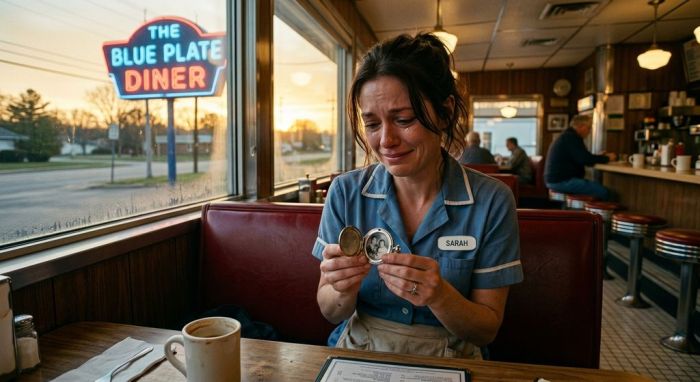
She reached into her purse again and pulled out a small, worn silver locket on a delicate chain. It was tarnished with age, the kind of tarnish that comes from being touched and held and pressed against skin for decades. She placed it on top of the envelope.
"I was you, Sarah. Forty-five years ago. I was a waitress at a diner just like this one, in a small town in Kentucky. I had a little boy, just like you. His name was Tommy. His father left when he was a baby, just like yours did. I worked double shifts, I ate canned soup for dinner, I wore shoes with holes in the soles because I couldn't afford new ones. And every single night, I asked God the same question: 'How am I going to do this? How am I going to raise this boy on my own?'"
She paused, her eyes glistening.
"Tommy is a doctor now. A cardiologist in San Francisco. He has a wife and two children and a house with a garden. He calls me every Sunday, without fail, just to say he loves me." She smiled, the lines around her eyes deepening. "He bought me this locket with his first paycheck. He said it was so I could carry his picture close to my heart, the way I carried him close to my heart all those years."
She opened the locket. Inside was a photograph of a young man in a white coat, his arm around a woman Sarah assumed was his wife. He was smiling, relaxed, successful.
"I don't need this anymore," Ruth said softly. "I have the real thing. I have him. And I want you to have this."
Sarah's hand flew to her mouth. "Ruth, I can't —"
"You can. You will." Ruth pushed the envelope and the locket closer. "The envelope has a check in it. It's not a fortune, but it's enough to cover a few months of rent. Enough to give you some breathing room. Enough to let you sleep through the night without wondering how you're going to make ends meet."
Sarah was crying now, silent tears streaming down her face. "Why? Why would you do this for me?"
Ruth reached across the table and took Sarah's hand. Her skin was papery and thin, but her grip was surprisingly strong. "Because someone did it for me. Forty-five years ago, a woman named Eleanor left me an envelope just like this one. She was a regular at my diner. She had watched me struggle, the same way I have watched you. She told me the same thing I am telling you now: 'You are not alone. You are stronger than you know. And your son will grow up to be the man you always dreamed he would be, because you loved him through the hard years.'"
She squeezed Sarah's hand. "I have carried Eleanor's kindness with me for forty-five years. I have paid it forward a dozen times, in small ways. But you, Sarah — you are my last one. I am eighty-two years old. I don't have many years left. And I wanted my final act on this earth to be something that mattered."
Sarah looked down at the locket in her hand, at the photograph of the successful young doctor. She thought about Ethan, asleep in his bed at this very moment, his small chest rising and falling, dreaming whatever dreams seven-year-old boys dream.
"I don't know what to say," she whispered.
"Say you'll keep going," Ruth said. "Say you'll show this locket to your son one day, when he is a man. Say you'll tell him the story of the old woman at the diner who saw his mother struggling and reminded her that she was not alone."
They sat in silence for a long moment, two women separated by forty-five years but bound by the same struggle, the same love, the same quiet, stubborn refusal to give up.
Then Ruth stood up. She picked up her purse, pulled on her coat, and smiled down at Sarah with the kind of warmth that could have heated the entire diner.
"Thank you for the coffee, dear. And the muffin. Best blueberry muffin in Nashville."
She walked out of the diner, the bell above the door jingling behind her. Sarah watched her go, watched her small figure disappear into the gray November morning, and then she looked down at the envelope.
Her hands were trembling as she opened it. Inside was a check for five thousand dollars and a handwritten note on a piece of yellow lined paper.
The note read:
Dear Sarah,
You are doing a beautiful job. Your son will not remember the nights you worked. He will not remember the bills you struggled to pay. He will remember the way you kissed his forehead when you tucked him in. He will remember the way you held his hand when he was scared. He will remember that you were there — not all the time, but when it mattered most.
You are stronger than you know. You are braver than you believe. And you are more loved than you can possibly imagine.
With all my heart, Ruth
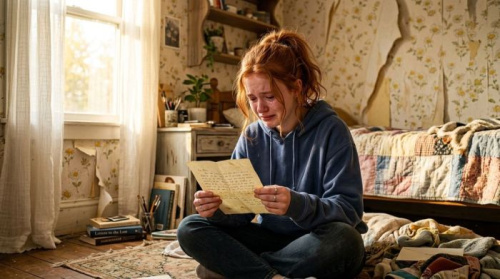
Sarah sat down in the booth — Ruth's booth, the one by the window — and let the tears come. She cried for the years of exhaustion, for the sleepless nights, for the moments she had felt like she was failing. And she cried for the kindness of a stranger who had seen her struggle and decided to help, not because she owed anything, but because love was the only currency that ever really mattered.
That was three years ago.
Sarah still works at The Blue Plate, but she no longer works the overnight shift. The check from Ruth gave her enough breathing room to find a better job — a daytime position at the same diner, with better hours and better pay. She gets to pick Ethan up from school every day now. She gets to watch him do his homework, help him with his reading, take him to his baseball practices on Saturday mornings.
Ethan is ten years old now. He is tall for his age, with a gap-toothed smile and a heart so big that Sarah sometimes wonders how it fits in his chest. Last week, he came home from school with a drawing he had made in art class. It was a picture of a woman in a waitress uniform, holding a tray of coffee cups, with a crown on her head.
"Look, Mom," he said, holding it up. "I drew you. You're the queen of the diner."
Sarah laughed, the kind of laugh that comes from somewhere deep and real. She hung the drawing on the refrigerator, right next to the photograph of a young doctor in a white coat.
She still carries the locket. It hangs around her neck every single day, tucked beneath her uniform, close to her heart. On the hard days — and there are still hard days — she opens it and looks at the photograph of Ruth's son. She reminds herself that the waitress from Kentucky raised a doctor. She reminds herself that the single mother with the leaky roof and the broken-down car raised a man who saves lives.
And she thinks about Ruth, wherever she is, and the gift she gave that went far beyond five thousand dollars. She gave Sarah something that no amount of money could ever buy.
She gave her hope.
Somewhere in Nashville, there is an old woman who once changed a young mother's life with a silver locket and a handwritten note. And somewhere in the future, there is a little boy who will grow up to be a man, holding a photograph of his mother in a waitress uniform, telling his own children the story of the queen of the diner.
Because that is the truth about kindness. It does not end when the moment passes. It echoes. It ripples. It travels through time and space, touching lives we will never know, shaping futures we will never see.
Ruth knew this. And now Sarah knows it too.
And maybe, one day, when Sarah is old and silver-haired, she will find a young mother at a diner somewhere, struggling and exhausted and barely holding on. And she will reach into her purse, pull out an envelope, and say the words that Ruth said to her.
"Keep going. You are stronger than you know. And your son will grow up to be the man you always dreamed he would be."
Because that is how hope travels.
One envelope at a time.