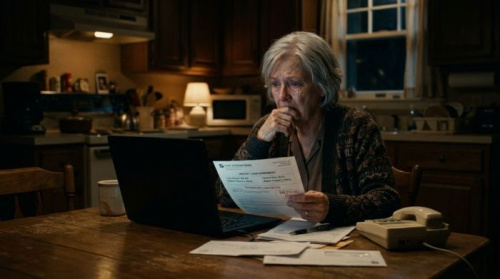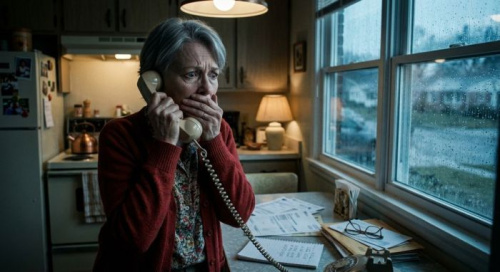
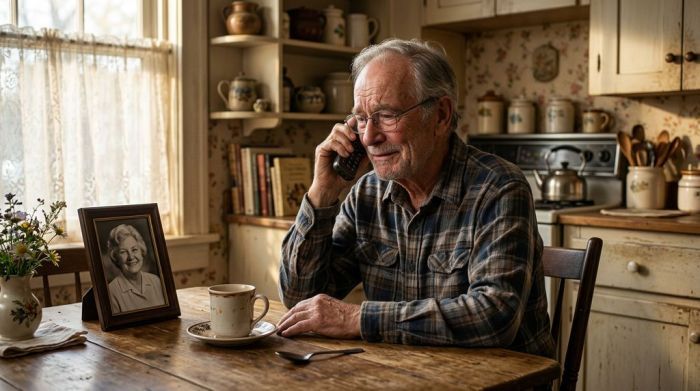
The first time I heard her voice after she was gone, it was a Tuesday afternoon in October. I was sitting in my recliner, the one she had bought me for our fortieth anniversary, staring at the wall the way I had done every day for the past six weeks. The phone rang — the landline, not my cell — and I let it go to voicemail like I did with almost everything that year. I did not have the energy for conversations. I did not have the energy for anything.
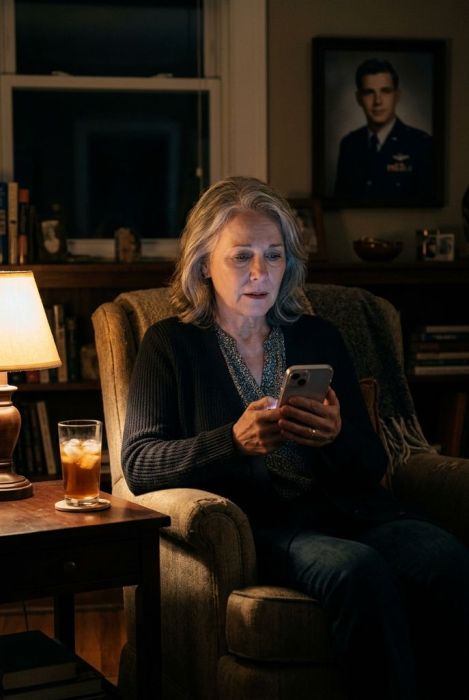
But when the voicemail notification pinged on my cell phone a few minutes later, I picked it up out of habit. And that was when I saw it.
One new voicemail. From Eleanor.
My wife had been dead for six weeks. And here was a voicemail from her, sitting in my inbox, waiting to be heard. I stared at the screen for a long time, my thumb hovering over the play button. My heart was beating so hard I could hear it in my ears. I pressed play.
"Hi, honey. It's me. I'm at the grocery store and I forgot to ask if you wanted the regular oatmeal or the steel-cut kind. Call me back when you get this. Love you."
Her voice. The same voice that had called me "honey" for forty-seven years. The same voice that had sung lullabies to our children, argued with me about where to hang the Christmas lights, whispered "I love you" in the dark every single night before we fell asleep. Her voice was warm and alive and completely ordinary — a mundane question about oatmeal from a woman who had no idea she only had three days left to live.
I listened to that voicemail seventeen times that night. I listened to it at her funeral, sitting in the front row, my phone hidden in my palm. I listened to it on the first Thanksgiving without her, on Christmas morning, on our anniversary. I listened to it on the bad days, the days when the grief was so heavy I could barely get out of bed.
And I never deleted it.
That was nine years ago.
My name is Harold Patterson. I am seventy-eight years old. I live in Austin, Texas, in the same house Eleanor and I bought in 1987, when our youngest was starting kindergarten. The house has changed since she left. The garden she tended with such care has been taken over by weeds. The kitchen she kept spotless is now cluttered with takeout containers and dirty dishes.
But one thing has remained exactly the same. That voicemail.
For nine years, I have kept that voicemail on my phone. I transferred it from phone to phone — from the old flip phone to a smartphone, from that smartphone to the next. I backed it up on my computer, on a flash drive, on the cloud. I have listened to it over three thousand times. I know every pause, every breath, every inflection.
It is not a profound message. It is not poetic. It is not the kind of voicemail they play in movies, where the dying wife says something beautiful and final. It is a voicemail about oatmeal. And it is the most precious thing I own.
Last Tuesday, my phone stopped working.
It did not break dramatically. There was no crack in the screen, no water damage, no warning signs. I woke up, picked it up to listen to Eleanor's voice the way I did every morning, and the screen stayed black. I pressed the power button. Nothing. I plugged it in to charge. Nothing.
I drove to the nearest phone store, my hands shaking on the steering wheel. A young man named Mike — he could not have been older than twenty-five — looked at my phone with the kind of professional sympathy that salespeople are trained to wear.
"Looks like the motherboard is fried, sir," he said. "I'm sorry. There's nothing we can do."
"You don't understand," I said, and my voice cracked in a way that made him look up from the phone. "I have something on that phone. A voicemail. From my wife. She passed away nine years ago, and that voicemail is all I have left of her voice."
Mike set the phone down carefully. He looked at me — really looked at me — and I saw something shift in his eyes. The professional sympathy gave way to something real.
"Let me try," he said. "Give me a couple of hours. I can't promise anything, but let me try."
I sat in the waiting area of that phone store for two hours, watching the minutes crawl by on the clock above the door. I thought about Eleanor. I thought about the day she recorded that message. It was a Thursday, I remembered. She had gone to the store to buy ingredients for the oatmeal raisin cookies she made every fall. And now, nine years later, a twenty-five-year-old stranger was trying to save her voice from the dead circuits of a dying phone.
Mike came out at 4:47 PM. I will remember that time for the rest of my life.
"I got it," he said.
I broke down right there in the middle of the phone store. I cried the way I had not cried since the day of her funeral. Mike handed me a box of tissues and stood there, awkward and kind, not knowing what to do but unwilling to walk away.
He had transferred the voicemail to a new phone for me. He showed me how to find it, how to play it, how to back it up. And then he said something that stopped my breath.
"Mr. Patterson," he said quietly, "my grandmother passed away last year. She used to leave me voicemails every Sunday, just to say she loved me. I listened to them for months after she was gone. And then one day, my phone broke, and I lost them all."
He paused. His eyes were red.
"I wish someone had saved them for me."
I do not know if you believe in God or fate or the strange ways that the universe connects people. Before that day, I was not sure what I believed either. But I believe in this: Mike and I were supposed to meet.
We have dinner together once a month now. He comes to my house, and I cook the oatmeal raisin cookies that Eleanor taught me how to make. He tells me about his life — his failed relationships, his dreams of opening his own repair shop, his guilt over not spending more time with his grandmother before she passed. I listen. I tell him that love does not end when someone dies — it just changes shape.
He invited me to his wedding last spring. A small ceremony at a park in Austin, under a canopy of live oaks. He asked me to be there, to stand in the corner of the photographs, to represent something he could not quite put into words.
I stood in the back, holding my phone in my pocket, feeling the weight of Eleanor's voice against my thigh. And I thought about how a voicemail about oatmeal had led me here — to a park in Austin, watching a young man start his life, carrying the love of a woman I had lost nine years ago into a future I never expected to see.
That voicemail is still on my phone. I still listen to it every morning. But something has changed. I do not listen to it because I am drowning in grief anymore. I listen to it because I am grateful.
I am grateful for the ordinary moments. For the mundane questions. For the "Love you" that comes softer at the end, because she was already thinking about the next thing. I am grateful that my last few words from Eleanor were not something dramatic or cinematic. They were something real. They were something that could only have come from a woman who had no idea she was saying goodbye, because she thought she would be coming home.
And that, I have learned, is the truest form of love. Not the grand gestures. Not the perfect final words. But the daily, ordinary, unremarkable moments that we do not realize are precious until they are gone.
I help Mike with his grandmother's recipe sometimes. He calls me every Sunday, just like she used to call him. And I answer. Because I have learned that voicemails are not just messages — they are lifelines. They are proof that we were here, that we loved, that someone on the other end of the line cared enough to ask about the kind of oatmeal we preferred.
Eleanor's voicemail is nine years old now. Mike's grandmother has been gone for two years. And somewhere out there, in the vast, tangled web of the cloud, two voicemails are stored — one about oatmeal, one about love — carrying the voices of women who thought they had more time.
They did not have more time. None of us do.
But we have voicemails. We have memories. We have a Tuesday afternoon in a phone store where a young man saved an old man's heart from breaking.
And that, I think, is enough.
I still have the phone Mike fixed for me. It sits on my nightstand, next to Eleanor's photograph. Every morning, before I get out of bed, I press play. I hear her voice. I hear the grocery store announcements in the background. I hear her hesitation before "steel-cut kind."
And then I get up. I make my oatmeal — steel-cut, as it turns out, because that was what she bought that day, and I have eaten nothing else since. I sit at the kitchen table, in the house we built together, and I whisper the words I never got to say back to her.
"Regular oatmeal, honey. But I would have been happy with either."
And for just a moment, I feel her smile.