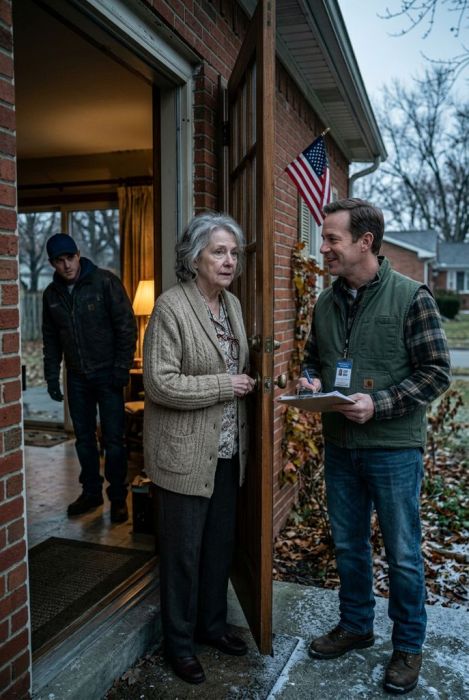

The first time Margaret Hartley noticed her grandson's lunch money disappearing, she blamed the vending machine. It was a small, foolish thing to blame, and she knew it even then. But it was easier than admitting that something at Wilson Middle School in Tulsa, Oklahoma, was quietly, carefully wrong.
Meg — everybody called her Meg, even the children — had been volunteering in the cafeteria for eleven weeks. She was sixty-two, a retired third-grade teacher who had buried her husband, Bill, two Novembers ago, and discovered that a house with one coffee cup in the morning felt twice as empty as a classroom with thirty desks. Her daughter Karen, an ER nurse who worked brutal double shifts, had suggested the school. "Mom, you need a reason to get dressed in the morning." Karen didn't know that Meg got dressed every single day anyway, out of habit, and sat in the living room watching the clock as though she were still waiting for something.
The cafeteria had a rhythm Meg understood the way she had always understood a classroom's hum. The roar of three hundred kids. The smell of reheated pizza. The eternal war over the last carton of chocolate milk. The sixth graders called her Grandma Meg within a week, and it settled something in her chest. Her grandson Ethan was in seventh grade, and she got to see him every day, even if he only waved from across the room when his friends weren't looking. He was twelve, at that age where being waved at by your grandmother in the lunchroom was a social hazard. She understood. She waved anyway.
The money began to vanish on a Tuesday in late October.
Ethan's lunch account kept coming up short. Three times in two weeks, the cashier's screen showed a negative balance, and three times Meg handed over five dollars from her own wallet and pretended it was nothing. But on the third time, she watched him. He bought the minimum — a cold sandwich, a water, never the pizza packets anymore. When she asked him about it, Ethan looked down at his tray and said, "I lost it." Meg had been a teacher for thirty-one years. She recognized a lie the way other people recognized a voice in a crowd. And she knew that particular lie by heart.
On Thursday she followed him. Not like a spy, she told herself. Like a grandmother. She watched him carry his tray to the far table by the windows and sit down across from a boy she recognized from the seventh-grade rolls: Marcus Reed. Marcus was new to Wilson, quiet, one of those children who moved through the world trying to take up no space at all. He looked at Ethan the way a small animal looks at a shadow. Then a big kid appeared beside the table.
Dylan Brooks was fifteen, a ninth grader, all shoulders and a practiced slouch. He wore a hoodie that read WILSON LEADERSHIP MENTORS in gold letters across the chest, and he smiled like a cashier at a carnival. Marcus's hands shook as he handed over a folded ten-dollar bill. Dylan slid it into his pocket, patted Marcus on the shoulder a little too hard, and said, "Good man. Same time next week."
Meg almost marched over. She didn't. She told herself she had misread the moment.
Then Grant Whitfield appeared in the lunchroom doorway, and everything about the picture snapped into focus. He was tall, forty-one, wearing a checked shirt and a cheerful rainbow tie, hands spread wide like he was about to bless the room. "Everything okay out here, Grandma Meg?" His voice was warm as fresh bread. "The mentoring program is the heartbeat of this school," he told her, his eyes on Dylan and Marcus. "We don't just teach these kids. We save them." He said the word save like it was something you could hold in your hand.
Grant Whitfield was the Student Support Coordinator, and everyone loved him. He hosted the anti-bullying assemblies. He organized the food drives. He gave little talks at PTA meetings where mothers wiped their eyes and told each other what a blessing he was. He had arrived eighteen months earlier from Nebraska carrying a folder of awards and a remarkable memory for children's names, birthdays, allergies, even the quiet details of their parents' divorces. He paid attention. That was the thing everyone said about Grant Whitfield. He paid attention.
And Meg noticed something else about the children in his Leadership Mentor program. They got things. New sneakers that cost more than their mothers could afford. Wireless earbuds. Money in their pockets at the taco truck on Fridays. Whitfield called those things "incentives for growth." The kids called it getting paid. Two of the older mentors wore thin gold chains that made Meg's stomach turn, and she could not have told you why.
She told Rosa instead. Rosa had worked Wilson's cafeteria for fourteen years and had seen every trick a school can hide. She scraped trays with a spatula the size of a canoe paddle and did not miss much. "You know what I notice? The kids in the program never get detention. No matter what. And the quiet ones — the ones who never have money — those are the ones Whitfield always has his eye on." She lowered her voice. "He calls it outreach. I call it collecting."
"That's a serious thing to say, Rosa."
"I'm a serious lady," Rosa said. "And I keep my mouth shut because I need this job. But you're retired, Grandma Meg. You can say the things I can't."
The first Friday in November, Ethan stopped sitting with his friends. Meg watched him eat alone at the far table, head down, moving his sandwich around the tray. When she approached, he flinched. Before she could ask, Karen called. "Mom, come home. Ethan got suspended. He punched Dylan Brooks." By the time Meg reached the porch, Ethan was sitting on the steps holding his knuckles, and he did not try to lie to her.
"He took Marcus's lunch money again, Grandma. Right in front of me." Marcus's father was deployed with the Army somewhere Marcus wasn't allowed to say. His mother worked nights at a diner. And every single week, Marcus handed Dylan Brooks twenty dollars so he could walk through the cafeteria without being afraid. Twenty dollars a week. That was the price of not being a target. Ethan had told Dylan to leave Marcus alone, and Dylan had laughed and said Marcus's daddy was never coming home anyway, and Ethan had hit him.
Karen came out onto the porch with two cups of tea. She was furious — at the school, at herself, at the world that kept handing her the broken pieces of other people's nights. But she begged Meg to let the school handle it. "Mom, they'll just say you're the grieving widow making trouble for the best counselor they've ever had."
Meg had already heard those words. Principal Okafor had said nearly the same thing that afternoon, sitting behind her desk with her hands folded, her voice kind and final. "Grant is vetted. He's our top performer. He's beloved, Margaret. I need you to understand that." Okafor had looked at Meg the way you look at a person who is about to make a scene. Within a week, the whispers started — PTA mothers in the parking lot, sympathetic sighs, the phrase bless her heart murmured like a verdict.
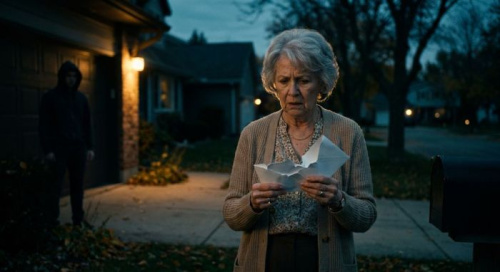
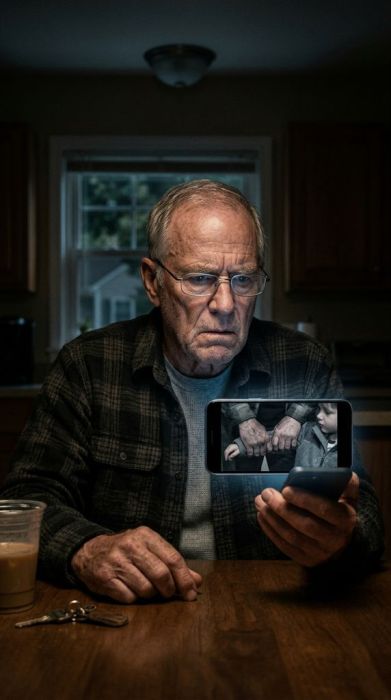
Then the text arrived on Ethan's phone. An unsaved number. "Tell your grandma to stop asking questions, or the next time I see you, nobody will believe it was an accident." Ethan showed it to Meg with shaking hands. She read it twice. Somewhere in her chest, a door clicked shut. She was not wondering anymore. She was hunting.
That night Karen tried one last time, over a pot roast Meg didn't taste. "Mom. Drop it. For Ethan. For you."
Meg set down her fork. "Karen, I taught school for thirty-one years. I have seen children cry in the last row because of what happened in the cafeteria. And I have seen the adults who were supposed to catch it look away." She paused. "I looked away once. I was thirty years younger, and I have never forgiven myself." She told her daughter about Tammy, a girl who had vanished from her classroom in 1994, bullied out of the district by other children while an adult who knew better said nothing. Meg had made a promise to herself on the last day of that school year: never again would she be the one who looked away.
The Leadership Mentor program had a public fundraising page — Wilson Leadership Mentors: Building Tomorrow's Citizens. Donations looked small. Five dollars. Twenty dollars. But Whitfield drove a new SUV with a fresh lease sticker, and the more Meg watched, the more the pattern revealed itself. The mentors were drawn from children who were already struggling. The rewards were expensive. And the collection, once a week, like a church tithe, ran on the rhythm of lunch money.
She found his biography online. Eighteen months earlier he had come from Lincoln Middle School in Nebraska, "answering the call to serve." On the third try, a retired secretary named Irene answered the phone. "We're not supposed to talk about it," Irene said carefully. "But a fundraising discrepancy. That's what they called it. The board paid him to leave quietly. Receipts, bake sales, candy money. And an account that should never have had his name on it." She paused. "Check the account that collected the money. That's what I would do."
Meg did. Her friend Alice had worked at the credit union for thirty years and knew exactly where to look. The account was in a name the school had never heard — a scholarship fund Grant Whitfield had opened for the program. Deposits arrived every Friday. Small, steady amounts, exactly the rhythm of children's allowances and crumpled bills. Seven hundred dollars some weeks. Twelve hundred others. Every week, without fail, for a year.
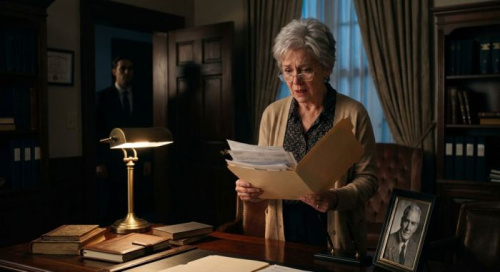
Meg took the stack of evidence to Principal Okafor's office. She brought Rosa with her. Rosa, who had said she needed the job, walked in anyway, because she had watched Whitfield take a sixth grader into his office alone and come out smiling. Rosa gave the principal names. Dates. The corner of the gym where the cameras didn't reach because Whitfield had asked for those cameras repositioned "for student privacy." Okafor stared at the papers for a long time. "I want to believe this is a mistake," she said quietly.
"So do I," Meg said. "But I was wrong about a girl named Tammy once because I let myself believe what was easier. I'm not letting that happen twice." Okafor's voice cracked when she answered. "I have to report this. You understand that." And Meg knew, sitting there in the quiet office with the afternoon light falling across the American flag, that the silence had already broken.
Detective Calderón of Tulsa PD listened to the whole story without interrupting once. Then she said, "Marked bills. That's how you catch this kind of heart." So they marked forty dollars in twenties. Ethan, pale but steady, handed the money to Marcus. Marcus handed it to Dylan Brooks under the bleachers, where no camera could see. And on Wednesday, at 2:47 in the afternoon, Dylan carried the envelope into Grant Whitfield's office.
At 2:52, Rosa knocked once on Whitfield's door. "Mr. Whitfield, there's a parent in the front office asking about the mentorship fund." She did not wait for an answer. She walked in, and behind her came Meg, and Karen, and Detective Calderón, and two uniformed officers.
Whitfield smiled first. It was the warm, practiced smile that had disarmed a hundred PTA meetings. "Officers, this is a misunderstanding. This is a safe space for children."
Calderón held up the envelope. "Mr. Whitfield, the twenties inside this envelope have serial numbers recorded by the Tulsa Police Department. The deposit slip in your wallet belongs to an account at a credit union that has never heard of Wilson Middle School." And next to him, fifteen-year-old Dylan Brooks — still wearing the gold-lettered hoodie — began to cry. "He said we were family," Dylan whispered. "He said we were saving kids. He said I was going to be somebody."
Whitfield's smile did not move for a long, terrible moment. Then it fell, the way a mask falls on a tile floor.
They found the ledgers in his office safe, three years of neat columns — names, amounts, dates, written in the tidy hand of a man who had once graded spelling tests. They found a copy of the Lincoln settlement, sealed by a district that had never paid to seal it properly. They found receipts for a car, for sneakers, for a down payment on a condo. And they found a note in Whitfield's handwriting, tucked behind a framed photo of smiling children: Nurture the quiet ones. They pay the longest.
Grant Whitfield was arrested for extortion and fraud involving minors. More charges followed when Nebraska opened the old file. Dylan Brooks went through a diversion program and, months later, wrote Marcus Reed a letter that made Meg cry in the school parking lot: "I'm sorry. I thought he was the only one who saw me." The mentorship program dissolved the week after the arrest, and the school board passed a resolution requiring every adult in every program working with children in the district to pass the same vetting as a teacher.
Marcus's father came home six weeks early, on emergency leave. Meg saw them at the grocery store — a soldier in uniform, a boy pushing the cart like it was armor, laughing at nothing. She didn't approach. Some reunions are private. But she waved, and Marcus waved back, and that was enough.
Months later, Karen sat at her mother's kitchen table on a Sunday and asked the question she had been carrying. "How did you know, Mom? How did you keep pushing when everybody told you to stop?"
Meg thought about it slowly, honestly. "Because nobody was watching the lunchroom, sweetheart. And the people who hurt children never do it in front of people who will really look." She paused, gazing at Bill's empty cup at the end of the table. "And because I made a promise to a girl named Tammy in 1994 that I would never again be the adult who looked away."
The cameras at Wilson Middle were never moved back. Meg requested, in writing, that the lunchroom camera angle over by the far windows stay exactly where it was — pointed at the table where children ate alone. Nobody argued with the volunteer who keeps a copy of everything. And every single school day, Grandma Meg Hartley stands in that doorway, watching children eat, learning their names, paying attention.
Because that is the truth this story is built on: the predators who hide behind kindness depend on the rest of us looking away. Bullies — even grown ones in rainbow ties — only survive in the shadows. And the strongest weapon a grandmother, a neighbor, a coworker, or a friend has is the simple willingness to watch, to ask the question nobody wants asked, and to refuse to be told to stop caring. If you see a child who is suddenly secretive, suddenly short on lunch money, suddenly afraid of a favorite adult — do not turn away. That is the moment that matters.