The first sign was not the missing pallets. It was the way Brett Landry's office light stayed on past midnight for three straight weeks, and the way the 3 a.m. trucks kept leaving the yard with their liftgates down and their paperwork unfinished. Joanne Mercer noticed because she always noticed. Twenty-eight years at the Alden Foods distribution center in Fort Wayne, Indiana, had taught her that small inconsistencies were like loose threads — you pull one, and the whole sweater unravels.
She was sixty-two years old, with steel-gray hair pinned in a practical bun and reading glasses hanging from a chain she had bought at a church rummage sale. The younger warehouse staff called her Miss Joanne, or simply "the clock," because nothing got past her. She knew which dock door stuck in humid weather, which forklift had a dying battery indicator, and which drivers took the scenic route to Indianapolis. What she did not know yet was that someone was stealing from the building she had helped keep honest for nearly three decades — and that the thief planned to make her the excuse nobody would question.
The new operations director had arrived in April with a laminated smile and a slide deck about "modernizing the legacy workforce." Brett Landry was thirty-eight, lean and athletic, with expensive shoes that squeaked on the concrete floor. Within a month he had replaced the paper inventory logs with a tablet system nobody over fifty quite understood, restructured the night shift, and started calling the older employees "the museum collection" in meetings he assumed she could not hear.
Joanne heard everything.
The shrink reports started climbing in May. Two percent on dock four, then three percent on dock seven. Brett stood in front of the whiteboard and blamed "process gaps" and "resistance to change," and his eyes kept drifting to the far end of the table where Joanne sat with her spiral notebook. Her name began appearing in emails she was not copied on. Her counts were audited twice a week. Her team was reassigned, one quiet transfer at a time, until the people who trusted her were scattered across the building like seeds in wind.
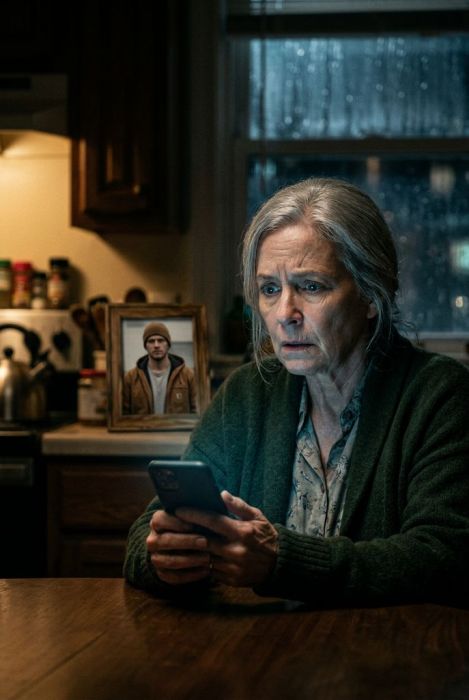
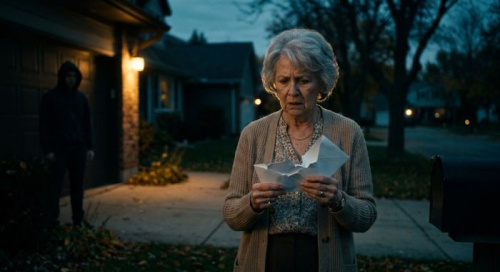
Her daughter Dana called from Cincinnati every Sunday and heard the worry creeping into her mother's voice. "He's going to push me out, honey," Joanne said one evening, standing at the kitchen window watching her own reflection in the dark glass. "He's going to make it look like I'm the problem."
"Then let him," Dana said gently. "You're sixty-two. Dad's pension, your savings — you'd be fine. You don't have to prove anything to anybody."
But Joanne could not retire, not like that. She had raised Dana alone after the accident on Route 24, worked double shifts, built a life from overtime and discipline. The money mattered, but it was not the whole of it. The warehouse was her second home, and the idea of leaving it with a stain on her name made her stomach turn. Something in her gut told her that if she walked away now, she would be carrying Brett's sin out the door with her, and the sin would find her no matter where she went.
The first loose thread appeared on a Thursday night in June. Joanne stayed late to close dock two after a driver shortage. Around 2:50 in the morning, she heard the rumble of a diesel engine in the yard. Through the window of her small office, she watched a white box truck with a faded logo — "Holloway Returns" — back up to dock eleven, the door nobody used anymore. Two men in high-vis vests loaded twelve pallets wrapped in clear film. The manifest sheets she caught a glimpse of were handwritten, dated wrong, and signed with a scrawl she did not recognize.
She told herself it was probably a returns haul. She told herself she was being paranoid, that a sixty-two-year-old woman who questioned everything would simply get herself fired. Then she pulled the dock camera footage from three nights earlier and found that the same truck had visited at the same hour, with the same handwritten sheets and the same two men. The footage had been flagged as "reviewed" by someone with Brett Landry's login.
Joanne began keeping a notebook. Not on the tablet system Brett had installed — that was his kingdom, and something about the bright blue dashboard had always felt like a locked door. She kept her records the old-fashioned way, in a spiral notebook she carried in her purse like a weapon. Pallet numbers. Seal numbers. Truck plates she copied by hand in the dark yard. She wrote down times in pencil, and she never once mentioned them aloud.
In July, Brett called her into his office and closed the door. He told her, with genuine-looking sympathy, that he had noticed "a few lapses" in her recent counts, that he was worried about her, that the company had a generous early retirement package and would help her "save face." Joanne looked at the framed efficiency awards on his wall and felt her heart hammering against her ribs.
"I'm not retiring, Brett," she said.
He smiled the way people smile at a stubborn child. "Then I'll have to escalate. Human resources will want to discuss your performance plan. We can both avoid that if you sign here." He slid a single sheet across the desk. Resignation, effective immediately, benefits through the end of the month.
Joanne did not sign.
Two weeks later, an iPad appeared in her locker. It was company property, and it contained files that should have lived on a restricted server. Loss prevention found it the same afternoon, and suddenly Joanne Mercer, the woman who had never missed a count in twenty-eight years, was the woman under investigation. The rumor mill did the rest: the old clock had finally slipped. She heard the whispers in the break room, saw the way younger supervisors looked at her with pity, and for the first time in her life she considered just signing the paper and walking away.
Marvin Ellison, a sixty-six-year-old forklift driver who had worked beside Joanne for two decades, found her crying in the break room and sat down across from her without a single word. He pushed a thermos of coffee toward her. "You know they hauled a load out last night at 2:40?" he said quietly. "Same white truck. Same logo."
Joanne stared at him. "You saw it too?"
"I've been seeing it for two months," Marvin said. "I thought I was going crazy. Figured if anyone would believe me, it'd be you. Nobody in this building trusts anyone over fifty anymore, and that's exactly how he wants it." He slid a grease-stained envelope across the table. Inside was a single photograph, taken with his phone through the wire mesh of the dock office window: two men in high-vis vests, and behind them, unmistakable in the sodium light, the silhouette of Brett Landry himself.
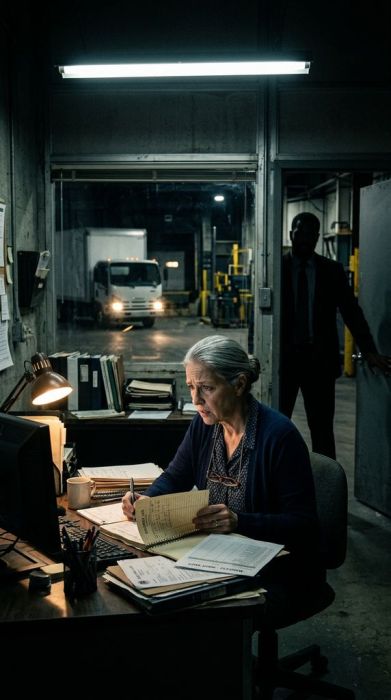
The photograph changed everything. Joanne stopped thinking about saving face and started thinking about the 3 a.m. trucks. She spent her nights in the warehouse office with the blinds drawn, cross-referencing her notebook against six months of delivery manifests that Terry in shipping had quietly printed for her — Terry was sixty-one, and he too had noticed the little things piling up. The trail was beautiful in its simplicity. High-value pallets were logged into Brett's tablet system but never assigned to outbound routes. They sat in the invisible corners of the software, in "quarantine" or "quality hold" or simply nowhere, until the white truck arrived to collect them for "returns."
Returns, Joanne learned, were the perfect crime. Nobody questions a return. Nobody audits a return. The pallets left the building legally, on paper, and the money flowed back through a shell company that billed Alden for restocking fees it never provided. Every deflected count, every "process gap," every late shift spent "retraining" the old employees — it had all been Brett's way of keeping the water muddy. He had not just stolen from the company. He had methodically discredited every pair of eyes old enough to catch him.
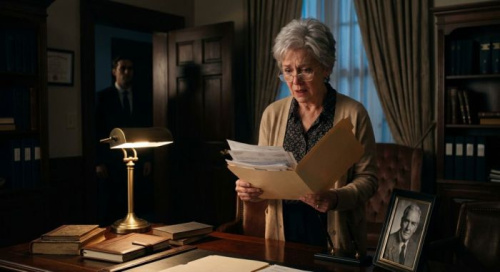
The night before the big meeting, Joanne almost didn't go. HR had scheduled a "disciplinary review" for Tuesday at 9 a.m., and she had spent the weekend imagining every terrible ending. But she remembered Marvin's photograph, and she remembered the look on Brett's face when she had refused his resignation letter, and she remembered something her own father used to say: you don't win arguments with loud voices, you win them with paper. So on Tuesday morning, she took a deep breath, put on her best blazer, and walked into the conference room with her purse held tight to her chest. The spiral notebook was inside it. So was the memory card she had copied from the dock cameras the night before — three minutes of footage she had pulled herself, at 2:47 a.m., while Brett Landry slept in his clean suburban bed.
Brett was already there, smiling, with a young woman in a charcoal blazer seated beside him. Her name was Nadia, and she was from the software company that had installed the tablet system. She had come to "support the transition," Brett explained, which Joanne thought was a strange thing to call a termination meeting. Then Joanne noticed the badge clipped to Nadia's blazer. It read Holloway Solutions.
The meeting began the way Brett always began things: with a summary of her failures, delivered with practiced sorrow. He talked about the iPad, the "pattern of lapses," the unfair burden she had placed on younger colleagues who were "just trying to do their jobs." He recommended immediate termination and, in the same breath, offered the retirement package again, as though he were doing her a kindness he expected her to be grateful for.
Joanne listened to the whole thing. Then she opened her purse and placed the spiral notebook on the conference table.
"Those are your returns," she said quietly. "Pallet numbers, seal numbers, license plates, dates. Forty-one loads in six months. I've written down every one of them."
Brett laughed, a short, sharp sound. "Joanne, you're reading from a notebook. Anyone can write a notebook."
"That's true," she said. "So I also kept the video." She slid the memory card across the polished wood toward Patricia, the HR director, a quiet woman who had not spoken a single word all morning.
Patricia looked at the card, then at Brett, then at the young woman from Holloway Solutions. "Nadia," she said slowly, "your badge says Holloway Solutions. The truck in the photo this gentleman was kind enough to take — what does that truck say on the side?"
Nadia's smile dimmed by a single watt.
They played the video on the conference room screen. It showed the white box truck backing into dock eleven at 2:47 a.m., the two men in high-vis vests, the handwritten manifest sheets fluttering in the sodium light. And then, because Joanne had been very thorough, it showed Brett Landry standing at the dock door with his tablet in his hand, watching the pallets roll past him like a man counting his own money.
The room went very quiet. Brett started talking about "vendor irregularities" and "misunderstandings" and "a hostile, delusional employee," and his voice kept rising until Patricia held up her hand. She had already dialed the number for corporate security on her desk phone. She had also, it turned out, been harboring her own quiet suspicions for a month. She just had not known who to trust with them. Joanne watched Brett's expensive shoes stop squeaking as he finally fell silent, and she understood that the long war was over.
They arrested Brett Landry three days later, along with two men from a storage facility on the outskirts of town, where nearly two million dollars' worth of stolen merchandise was recovered in neatly stacked pallets. Nadia's shell company, Holloway Solutions, turned out to own the storage facility. The software she had sold to Alden had been written with a quiet blind spot built in — a way to log merchandise into the system and then make it disappear without a trace. The warehouse had been bleeding for nine months, and the bright blue dashboard had been programmed to call it a scratch.
Joanne did not get a parade. She got her job back, an apology that meant nothing, and a quiet conversation with the district vice president about a new role in quality assurance, if she wanted it. She wanted it. She also wanted them to understand that she had kept her own paper copies, and that paper still beat software when it mattered. She kept the spiral notebook in her desk drawer for years after that, a reminder that the truth survives as long as somebody writes it down.
Dana drove up from Cincinnati that weekend, and they sat on the porch of the small house on Calhoun Street, drinking coffee the way they had when Dana was a girl. "You could have just retired," Dana said. "You could have let them win."
"I thought about it," Joanne admitted. "The day they called me a risk, I thought about it. But nothing goes missing forever, honey. Someone always sees. The trick is writing it down before they can make you doubt your own eyes."
She retired three years later, on her own terms, with a plaque and a standing ovation from the younger staff who had learned, one by one, that the clock had never once been wrong. The last thing Joanne did before she left was buy Marvin Ellison a new thermos. The old one still had his coffee in it, and the way she told it, that thermos had saved her life — one quiet morning in a break room, when she had almost believed that she was the one who was broken.
Now, in the small house on Calhoun Street, Joanne sometimes watches the evening news and sees the stories: the audits, the whistleblowers, the older workers quietly "let go for performance" who never got the chance to fight back. She does not watch for revenge. She watches because she knows now that the 3 a.m. trucks are never really gone. They just learn to use a different logo. The only difference, in the end, is whether someone was watching — and whether that someone wrote it down in pencil, before anyone could convince them they had imagined it.