The last time James O'Connor danced, his wife Martha was still alive. He did not know it would be the last time. That is how it works, is it not? The most important moments of our lives arrive dressed as ordinary days, and we never think to say goodbye properly.
She had asked him to dance in the kitchen while she was washing dishes. A Frank Sinatra song was playing on the old radio — "The Way You Look Tonight." He had grumbled about his knees, about how tired he was from fixing the garden fence, about how the floor was slippery. But she had taken his hand, placed it on her waist, and rested her head against his chest the way she had done for fifty-two years. And he had danced with her, right there in the kitchen, between the stove and the refrigerator, surrounded by the smell of meatloaf and the sound of running water.
She passed away three weeks later. A stroke. Quiet. Sudden. The kind that gives you no time to prepare, no time to say the things you should have said every single day but somehow never did.
That was two years ago. James had not danced since.
The Photograph in the Attic
His granddaughter Lily found the photograph on a rainy Sunday afternoon in October. She was nineteen years old, a sophomore at Wayne State University, majoring in elementary education. Every Sunday, without fail, she drove the forty-five minutes from her campus apartment to his small house on Oakwood Avenue in Detroit. She brought groceries, checked his blood pressure, made sure he had taken his heart medication. She was the only family he had left.
"Grandpa," she called down the stairs, her voice carrying that particular mix of excitement and tenderness that she had inherited from her grandmother. "I found something!"
James was in the kitchen, heating up a can of soup. He did not have the energy to cook anymore. The kitchen felt too big without Martha standing at the stove, stirring something that smelled like home. He climbed the stairs slowly, his knees reminding him of every one of his seventy-four years.
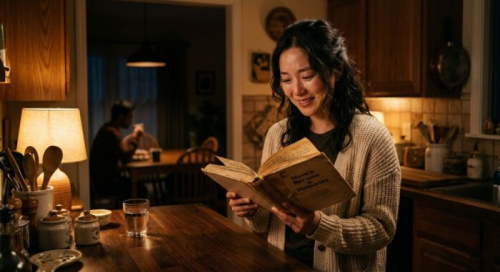
Lily was sitting cross-legged on the floor of the attic landing, surrounded by cardboard boxes that had not been opened since the funeral. She held up a photograph, slightly yellowed at the edges, the colors faded to sepia tones. It showed a young couple dancing at a wedding reception. The man was tall and lean, with dark hair and a confident smile. The woman was beautiful, her head tilted back in laughter, her dress a simple pale blue that matched her eyes.
"That's your grandmother," James said. His voice cracked on the last word.
"I know," Lily said softly. "Look at her. She was so beautiful." She was quiet for a moment, studying the photograph. "And look at you, Grandpa. You had so much hair."
James laughed, a dry, rusty sound he had not made in months. "I had a full head of hair and two working knees. That was a good year."
Lily turned the photograph over. On the back, in Martha's graceful handwriting, it said: July 17, 1971. The best night of my life. I danced with Jimmy until my feet gave out. He promised me he would never stop dancing with me. And I believed him because when Jimmy O'Connor makes a promise, he keeps it.
Lily looked up at him, her eyes glistening. "You promised her you would never stop dancing?"
James took the photograph from her hands. He stared at it for a long, long time. "I don't dance anymore, Lily. The music stopped when she left."
"Then learn again," Lily said simply.
He shook his head. "I can't. It would hurt too much."
"Grandpa," she said, taking his hands in hers, "will you teach me to dance?"
James opened his mouth to refuse. The words were right there, ready to defend his grief, to protect the memory of his wife from the clumsy feet of a nineteen-year-old who did not understand. But then he looked at Lily's face, at the earnest hope in her eyes, at the way she held the photograph with such reverence, and he saw Martha looking back at him. The same stubborn chin. The same kind eyes. The same refusal to let him retreat into his sadness.
"I'm not as good as I used to be," he said quietly.
"That's okay," she replied. "I'm not good at all. We'll be bad together."
Learning to Move Again
The first lesson was a disaster. James put on a record — Frank Sinatra, "Fly Me to the Moon" — and took Lily's hand the way he used to take Martha's. But his body had forgotten. His feet shuffled awkwardly. His back seized up after three minutes. He stepped on Lily's toes twice and apologized so many times that she started laughing.
"Grandpa, relax," she said, squeezing his hand. "You're teaching me, remember? I'm your student. You're supposed to make mistakes in front of me so I feel better about my own."
He laughed again, and this time it came easier.
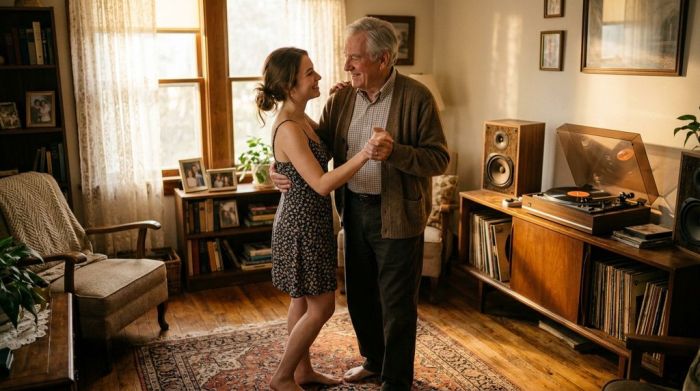
They set a schedule. Every Sunday, after the groceries were put away and his blood pressure was checked, they would push the coffee table against the wall and turn on the record player. James taught her the foxtrot first, then the waltz, then the simple two-step that he and Martha had danced at every family wedding for five decades.
And as he taught her, something remarkable happened. The memory of Martha stopped being a wound that he protected and started becoming a gift that he shared.
"Your grandmother loved to dance," he told Lily one Sunday, as they swayed to "Moon River." "She would drag me to every dance the VFW hall hosted. I used to pretend I was going because she made me, but the truth is I loved watching her move. She was so full of joy when she danced, like nothing else in the world existed except the music and the moment."
Lily rested her head on his shoulder. "Tell me more about her."
And he did. He told her about the night they met — a church social in 1967, where Martha had walked up to him and asked him to dance because she saw him "standing against the wall like a lost puppy." He told her about their wedding, how she had worn her mother's veil and carried wildflowers because she refused to spend money on something that would wilt in a day. He told her about the night Lily's father was born, how Martha had gripped his hand so hard he thought his fingers would break, and how she had looked at their son and said, "We made this. We made a whole person."
Week after week, the stories poured out of him. And with each story, the house on Oakwood Avenue began to feel less like a museum of grief and more like a home again.
The Song He Could Not Play
There was one song James would not play. Lily noticed it after a few weeks. She would browse through his record collection — a beautiful assortment of Sinatra, Nat King Cole, Ella Fitzgerald, Dean Martin — but there was one record she never saw him put on.
"What about this one?" she asked one day, holding up a worn album sleeve. It was Frank Sinatra's "September of My Years."
James's face changed. The light in his eyes dimmed. "Not that one," he said quietly.
"Why not?"
He took the album from her and held it with both hands, the way a priest might hold a Bible. "This was playing the night she left. At the hospital. They let me bring a record player into her room. I held her hand and she smiled at me, and I told her that I would find her in the next life. I told her to save me a dance."
Tears ran down his face, and he did not wipe them away.
"The last song she ever heard was 'The Way You Look Tonight.' The same song we danced to in the kitchen. The same song from our first dance at our wedding." He placed the record back in its sleeve. "I can't listen to it, Lily. It would break me."
Lily did not push him. She simply took his hand and held it, the way he had taught her to hold a dance partner. "That's okay, Grandpa. We don't have to play it."
The News That Changed Everything
Spring came slowly to Detroit that year. The snow melted, the tulips pushed through the frozen ground, and the house on Oakwood Avenue began to smell like fresh air and possibility. James had started cooking again. Not elaborate meals — just simple things, eggs, toast, the occasional pot roast. But he was cooking. That was what mattered.
And then, on a warm April afternoon, Lily arrived with news that made his heart stop.
"I'm getting married," she said, barely able to contain her smile. "His name is David. He's in my education program. He proposed last night, and I said yes."
James pulled her into a hug that surprised them both with its strength. "Your grandmother would have loved this," he whispered into her hair. "She would have been so proud."
Lily pulled back, her eyes bright with tears and something else — a question she was almost afraid to ask. "Grandpa, will you dance with me at my wedding?"
James felt the words catch in his throat. He thought about the last dance, about the kitchen, about the way Martha's hand had felt in his. He thought about the record player in the hospital room. He thought about the promise he had written on the back of that photograph in 1971.
"Nothing would make me prouder," he said.
The Wedding Day
Lily's wedding was held at a small church on the outskirts of Detroit, the same church where James and Martha had been married fifty-four years earlier. The pews were decorated with wildflowers — just like Martha had insisted on for her own wedding. The sun streamed through the stained-glass windows, casting patterns of blue and gold across the aisle.
James wore his best suit, the one he had worn to funerals for the past two years. But today, it was for a wedding. A beginning, not an end.
Lily walked down the aisle on his arm. She was radiant in a simple white dress, and for a moment, James allowed himself to pretend she was Martha, walking toward him on their wedding day. The same glow. The same smile. The same joy that lit up a room.
He placed her hand in David's. He kissed her cheek. He took his seat in the front row, and he watched his granddaughter begin the journey he had begun fifty-four years ago — the sacred, terrifying, beautiful journey of spending a lifetime with someone.
And then, during the reception, the moment arrived.
The DJ announced the father-daughter dance. Lily's father — James's son — had passed away five years ago. So Lily had made a request, and the DJ made an announcement that silenced the room.
"Lily has asked for a special song for her dance with her grandfather, James O'Connor."
The first notes of "The Way You Look Tonight" filled the hall.
James felt his breath leave his body. He looked at Lily, who was walking toward him, her hand extended, her eyes full of love and understanding. She had planned this. She had known that he would need to dance this dance. She had given him the gift of facing his greatest fear in the safest possible way.
"I can't," he whispered, but his legs were already moving.
"Yes, you can," she said, taking his hand. "Grandma wanted you to dance. She told you to save her a dance, remember? This is it, Grandpa. This is the dance."
He took her in his arms — the way he had taken Martha on their wedding day, the way he had taken her in the kitchen on that ordinary afternoon that turned out to be their last. And they began to move.
The room disappeared. The guests, the decorations, the camera flashes — all of it faded away. There was only the music, and the girl in his arms, and the woman he had loved for fifty-two years who was watching from somewhere beyond the veil.
James closed his eyes, and he saw Martha. She was wearing that pale blue dress from the photograph. Her head was tilted back in laughter. She was reaching for him, the way she always had, the way she always would.
I kept my promise, he thought. I never stopped dancing.
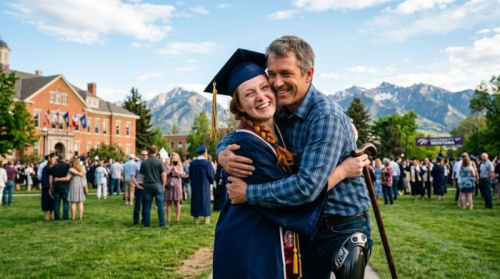
The song ended too soon, as all beautiful things do. Lily hugged him tightly, tears streaming down her face. "Thank you, Grandpa," she whispered. "Thank you for teaching me."
He held her close, feeling the warmth of her, feeling the continuity of love that stretched from 1971 to this very moment, from Martha to Lily, from one generation to the next.
"No," he said, his voice thick with emotion. "Thank you for teaching me that it's never too late to dance again."
Epilogue: One Last Dance
The photograph from Lily's wedding sits on James's nightstand now. It shows him and Lily in the middle of their dance, both of them laughing, both of them crying, both of them alive in a way that only people who have loved and lost and loved again can understand.
Next to it is the old photograph from 1971 — James and Martha, young and beautiful and full of promise, dancing at a wedding that started it all.
James O'Connor is seventy-six years old now. He still heats up soup for dinner sometimes. His knees still ache when it rains. He still misses Martha every single day, with a depth of longing that has not diminished one bit since the day she left.
But on Sunday afternoons, he pushes the coffee table against the wall. He puts on a Frank Sinatra record. And he dances. He dances alone, with the ghost of his wife, with the memory of his granddaughter's wedding, with the joyful knowledge that love does not end when someone dies. It just changes shape. It becomes something you carry in your chest, something you pass on to the people you love, something you dance to — even when the music has stopped.
And if you listen closely, on quiet Sunday afternoons on Oakwood Avenue in Detroit, you can still hear the sound of shuffling feet, and the faint melody of a man who kept his promise.
He never stopped dancing.