Rob Harrison never expected to find himself standing in the middle of his backyard on a humid August evening, holding a baseball mitt that his son had never once asked for. The grass was overgrown, the garden hose coiled like a sleeping snake near the fence, and the only sound was the distant hum of an ice cream truck somewhere down Sycamore Street.
Rob was forty-two years old. He sold life insurance for a living. He had a mortgage, a minivan with a dent in the rear bumper, and a wife named Diane who worked nights as a nurse at the county hospital. By most measures, he was a successful man. But every time he looked at his son Tyler, he felt something he could never quite name. Not disappointment. Not anger. Something closer to helplessness.
Tyler was sixteen, a sophomore at Northwood High School. He was tall and skinny, with the kind of posture that suggested he was always trying to make himself smaller. His hair hung over his eyes, and he wore hoodies even in July. He did not play sports. He did not watch sports. He did not care about the Buckeyes, the Reds, or the Indians that had recently become the Guardians, a change that Rob still refused to acknowledge.
What Tyler cared about was drawing.
He drew constantly. On the margins of his homework, on napkins at dinner, on the back of receipts from the grocery store. He filled spiral notebooks with sketches of superheroes and monsters and landscapes from imaginary worlds. His backpack weighed twice as much as it should because it was stuffed with drawings he refused to throw away.
Rob did not know what to do with a son who drew.
He had tried, God knows he had tried. When Tyler was seven, Rob signed him up for Little League. Tyler spent the entire first practice sitting in the outfield picking dandelions. When he was ten, Rob bought him a basketball hoop for the driveway. Tyler used it once, missed every shot, and never touched it again. When he was thirteen, Rob took him to a Reds game. Tyler spent four innings drawing the scoreboard.
"Baseball is not complicated," Rob said one evening, standing in the backyard with two gloves and a ball. "You just throw the ball. I throw it to you. You catch it. Then you throw it back to me."
Tyler stood on the grass with his hands shoved into the pockets of his hoodie. The glove Rob had bought him hung from his left hand like a foreign object he was not sure how to hold.
"I know how it works, Dad."
"Then let's try."
Rob tossed the ball underhand. It arced through the humid air, spinning lazily. Tyler raised the glove, but his timing was off. The ball hit the heel of the glove, bounced out, and rolled into the overgrown grass near the fence.
"I'll get it," Tyler said, already walking.
Rob watched his son's back — those narrow shoulders, that defeated posture — and felt something crack open in his chest. It was the same feeling he got every time they tried this. The same quiet, crushing sensation that he was doing something wrong but could not figure out what.
"It's okay," Rob called out. "You almost had it."
Tyler picked up the ball. He did not throw it back. He stood there, holding it, staring at the ground.
"Dad, can we just —"
"One more. Just one more."
Tyler sighed. He walked back to his spot, raised the glove again. Rob tossed the ball gently, softer this time. The ball hit Tyler's glove, wobbled, and fell to the ground.
"I'm never going to get this," Tyler said quietly.
"Yes you will. It's just practice. You have to want it."
Tyler finally looked up. There was something in his eyes that Rob had never seen before. Not frustration. Not sadness. It was resignation.
"Dad, I don't want it."
The words hung in the air between them. Rob caught the ball Tyler tossed back to him. The game of catch was over. They walked back to the house in silence.
That night, Rob lay awake next to Diane, staring at the ceiling. The ceiling fan spun in slow circles, pushing warm air around the room.
"I don't know how to reach him," Rob whispered.
Diane turned toward him. Even in the dark, he could see the tiredness in her face. She had worked a double shift. Her voice was soft but firm.
"He's not broken, Rob. He's just not you."
"I know he's not me. That's the problem."
"The problem," Diane said, "is that you keep trying to play catch with a kid who wants to draw. You keep handing him a baseball glove when what he really needs is a new set of markers."
Rob said nothing. He knew she was right. He had always known she was right. But knowing and doing were two different things.
The next Saturday, Rob came home from work early. He found Tyler in his room, sitting on the floor surrounded by papers. His desk was covered in pencils, erasers, and empty soda cans. He did not hear Rob come in. He was too focused on the page in front of him, his pencil moving in quick, confident strokes.
Rob stood in the doorway and watched.
Tyler was drawing a comic strip. The art was surprisingly good — detailed, expressive, full of life. The panels showed a superhero with a cape and an ordinary face. Not a muscular, square-jawed hero. A skinny one. One who looked a lot like Tyler.
In the first panel, the hero tried to catch a falling object. He missed. In the second panel, he tried again. Missed again. In the third panel, he gave up trying to catch things and instead used his speed to push people out of the way. He saved the day not by catching anything — but by letting things fall and helping the people who got hurt.
Rob's throat tightened.
"Can I see it?" he asked.
Tyler jumped. He scrambled to cover the papers, his face flushing red.
"It's nothing."
"Can I see it, Ty?"
Tesitation flickered across Tyler's face. Then, slowly, he handed over the notebook.
Rob sat down on the edge of the bed and flipped through the pages. Page after page of a world his son had built entirely from imagination. A world where a hero who could not catch anything learned to save people in other ways. A world where being different was not a weakness.
Rob looked up. Tyler was watching him with a look of fear, waiting for his father to say something dismissive.
"Did you write this whole thing?"
"Yeah."
"How long did it take?"
"About four months."
Rob flipped to the last page. The final panel showed the skinny superhero standing on a rooftop, watching the sunrise. The caption read: "He never learned to catch. But he learned to be there."
"You know what I love about this?" Rob said.
Tyler shook his head.
"The hero doesn't change who he is. He just finds his own way."
Tyler blinked. For a moment, neither of them spoke.
"Yeah," Tyler said quietly. "That's the point."
Rob closed the notebook. He looked at his son — really looked at him — and for the first time, he saw the boy Tyler actually was, not the boy Rob had been trying to turn him into.
"I have an idea," Rob said. "What if we went to the art supply store tomorrow? I'll buy you whatever you need. And maybe... you could teach me how to draw a stick figure that doesn't look like a deformed potato."
Tyler laughed. It was a small laugh, surprised and hesitant. But it was real.
"You're going to be terrible at it," Tyler said.
"Probably. But I want to try."
The next morning, they drove to Michaels together. Tyler walked through the aisles like a kid in a candy store, picking up different pencils, testing the weight, holding them up to the light. Rob followed behind him, pushing the cart, saying yes to everything.
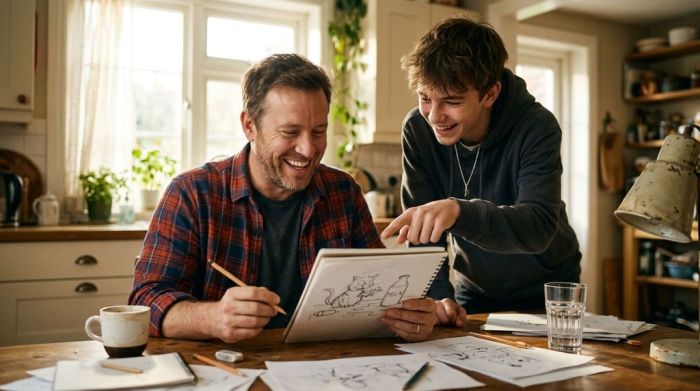
When they got home, Tyler set up two chairs at the kitchen table and placed a blank sheet of paper in front of his father.
"Draw a circle," Tyler said.
Rob drew a circle. It was lopsided.
"Okay. Not bad. Now draw an oval underneath it."
"Why?"
"Just trust me."
Twenty minutes later, Rob had drawn a very ugly penguin. He stared at it, then at Tyler's effortless sketch of the same penguin, and burst out laughing.
"This is terrible," Rob said. "I'm genuinely impressed by how bad this is."
Tyler was laughing too. "It's not that bad."
"Yes it is. This penguin looks like it's being electrocuted."
They spent the rest of the afternoon drawing. Rob's penguins never got any better, but somewhere between the third failed attempt and the fourth, something shifted. The tension that had lived between them for years began to dissolve.
When Diane came home that night, she found them still at the kitchen table. The table was covered in drawings. Rob was holding up a page with a dozen deformed penguins, and Tyler was leaning back in his chair, grinning.
"Look," Rob said, pointing at the worst penguin. "This one is you."
Diane looked at them. She did not say anything. She just smiled.
That night, Rob could not sleep again, but this time it was for a different reason. He lay in bed thinking about all the years he had spent trying to make his son into someone he was not. All the wasted Saturdays at baseball fields. All the unspoken disappointments. All the games of catch that Tyler had never wanted to play.
But he thought about the afternoon too. He thought about the look on Tyler's face when he said he wanted to learn. He thought about the comic book — the one about a hero who could not catch anything but saved the world anyway.
"Hey," Diane whispered. "You're thinking too loud."
"I know."
"Good thinking or bad thinking?"
"Good thinking," Rob said. "I think I finally get it."
"Get what?"
"That I've been trying to teach him something he didn't need to learn. And he's been trying to teach me something I didn't know I needed to learn."
Diane propped herself up on one elbow. "And what's that?"
Rob paused. "That being there is more important than catching anything."
Diane smiled. She reached over and squeezed his hand.
"He's a good kid," she said.
"He's a great kid," Rob said.
The next weekend, Rob bought a new notebook. He sat down at the kitchen table, picked up a pencil, and tried to draw a circle. It was still lopsided. But he kept going.
Tyler walked in, looked at his father's drawing, and laughed.
"You're holding the pencil wrong."
"Show me."
Tyler walked around the table. He adjusted his father's grip. Then he sat down next to him, picked up his own pencil, and started a new sketch.
And together, they drew.